Lent is a journey – from the wilderness to a place of being close to the heart of God.
To guide us on this journey, I invite you to join me in visiting Biblical locations in the Holy Land.
A Blessing: May God bless and keep you! May the radiant face of God shine upon you as we begin our Lenten journey from ashes and dust to the blossoming of the love of God. Amen
We begin today in the Wilderness.

The wilderness around Jerusalem is a windswept landscape of deep valleys and high cliffs formed by ancient waters flowing through the sandy land. Today the river beds are dry, except for trickles of water in the rainy season. These dry stream beds are called Wadis (pronounced wadees). These are pictures of the Wadi Qelt which is a 25 km path between Jerusalem and Jericho. Our seminary class walked about 15 km of that path on one of the hottest days of our stay (34C)
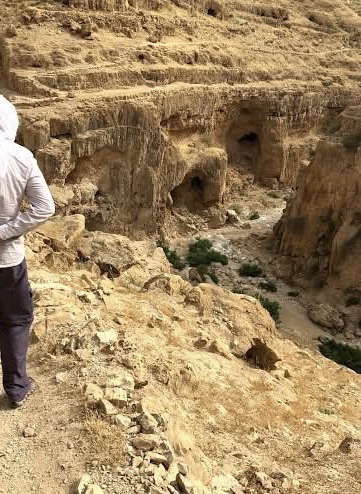

Biblical references to the wilderness: Rubin, eldest brother of Joseph, arranged for Joseph to be thrown into a pit in the wilderness instead of being killed by his jealous brothers. Ruben planned to return and rescue him later. (Genesis 37:22) Ruben felt alone in the wilderness but God was there.
Moses met God in a burning bush in the wilderness. Moses had tried to run away and he thought he was alone but God found him in the wilderness. (Exodus 3)
The Israelites wandered in the Wilderness for 40 years complaining to Moses anbout being taken from their homes (and lives of slavery). They wavered from trusting God, but God was with them, guiding and teaching them to live as people of God. (Exodus 14:11)
Jesus was tempted in the wilderness. (Matthew 4; Mark 1; Luke 4)
sometimes life gives us wilderness times which hijack the joy of living. What wilderness time have you experienced?
as you begin your Lenten journey open your hands and release those wilderness times to God who is always with you.

Prayer: Create in me a clean heart O God and renew a right spirit within me (Psalm 51: 10) Amen
pause your devotion here, or continue reading more about the wilderness in the Holy Land to learn how the wilderness is a place where change is very noticeable and growth does happen.
More about the Wilderness in the Holy Land
The trail we walked in Wadi Qelt is believed to be the same route travelled in the parable of the good Samaratin. As we walked we could see numerous caves where bandits could hide and come upon unsuspecting travellers.
the “Valley of the shadow of death” (Psalm 23) is also thought to be the walking path through Wadi Qelt, and at some seasons of the year when small amounts of water trickle through the river beds, it is said to be a most beautiful place. The river banks sprout flowers and the trickle of water draws birds so their songs fill the air. I like that image, because it contrasts a life without God, dry and barren, and a life with God, lush and alive
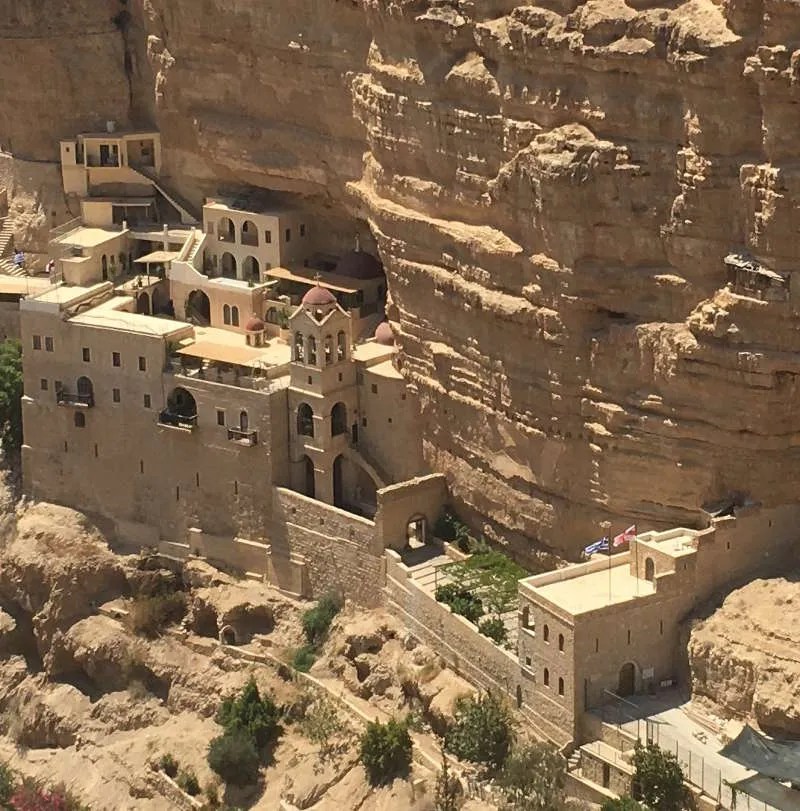
Around 500CE a monastery was constructed near the edge of Wadi Qelt, St. George’s Monastery is a Greek Orthodox cliff-hanging complex carved into a sheer rock wall in the Judaean Desert and is one of the most breathtaking sights in the Holy Land.
It is believed that Elijah visited the cave where the monastery is now located as he fled the threats of Jezebel after he killed the false prophets of Baal and Asherah. (1 Kings 19:1-3)
Around the 4th century, monks began to live in the many caves of Wadi Qelt and the monastery of St. George was founded in the 5th century by John of Thebes, an Egyptian. He gathered a small band of five Syrian hermits who had settled around the cave where they believed the prophet Elijah was fed by ravens (1 Kings 17:1–7).
The buildings were ravaged and destroyed through the years as warring nations battled and the crusaders travelled the lands.
In 1878, a Greek monk, Kalinikos, settled here and restored the monastery, finishing it in 1901.
We began our walk at the base of this monastery. It towered over us seeming to hang on the edge of the cliff, an impressive structure. The walk itself was, as you might imagine, hot and monotonous, the landscape changed very little and one horizon looked like the next. However, as we neared the end and saw buildings and palm trees I felt overwhelmed for some strange reason. I could barely speak for the emotion of having encountered an ordeal, and having made it through. That is the way of a wilderness journey. It will end and there will be joy.
In closing, bring to mind the words of Psalm 23. “Yea, though I walk through the valley of the shadow of death i will fear no evil for thou are with me. Thy Rod and staff comfort me.
Peace to you in your Lent journey.
Pastor Pam
 finding Grace in Surprising Ways