Approaching a most sacred site in Jerusalem, we bow in prayer: Jesus, Remember me when you come into your kingdom. Jesus remember me, Amen
Today we make our final stop for this devotion series. We arrive at The Church of the Holy Sepulchre, a holiest of holy Christian sites, revered as the site of the tomb and Resurrection of Jesus Christ. The church was planned to enclose the site of both Golgotha and the nearby tomb where Jesus was laid.

We entered and our eyes adjusted from the bright sunlight to see a glowing mosaic in the dim light of the entrance. Slowly, we were wrapped in the golden highlights of a brilliant mosaic of our Lady of Sorrows.
As we contemplated the authenticity of the claim that the cross of Jesus was once in this spot, Bishop Pryce came up behind us and gently said “go and touch the place of the cross”.
In other words, we were there and he encouraged us to enter into the full experience. (Thank you Bishop!)

So we moved from the shimmering entrance, and stood in line, recalling the events of the day Jesus was crucified.
Place of Crucifixion
Inside the church is a rocky outcropping which marks the traditional place where the cross was placed. Archaeological excavations have demonstrated that this site was outside the city but close to one of its gates and thus would have been a used as a location for a crucifixion. Today this chapel is controlled by the Greek Orthodox Church.
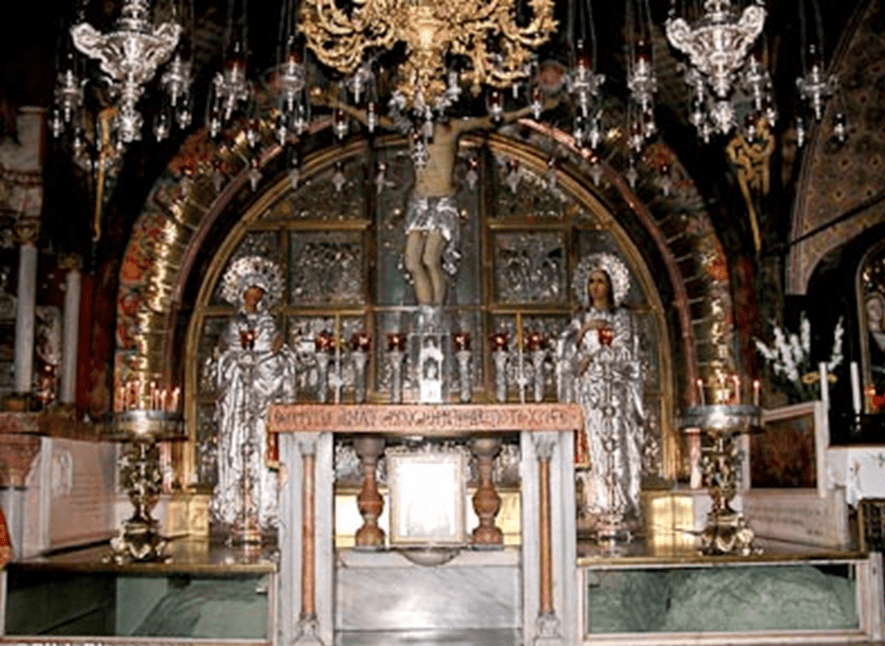
When my turn came, I knelt at the altar, and reached out my hand placing it into the crevice beneath the altar where Jesus’ cross had stood. The terrible cruelty of Jesus’ crucifixion became very real at that moment: Christ died at the hands of cruel and oppressive powers. From this place he had prayed: Father forgive them. Oh my heart!
I stood and slowly moved away from the place of the cross, wandering the chapels and thinking, until I came to the huge wall of mosaics.
Join me in looking at these pieces of art.
This is the hall of mosaics. The anointing stone is also here – the place where Jesus’ body was laid for quick anointing before being placed in the tomb.

Mosaic image of anguished angels weeping at the cruelty in the world.
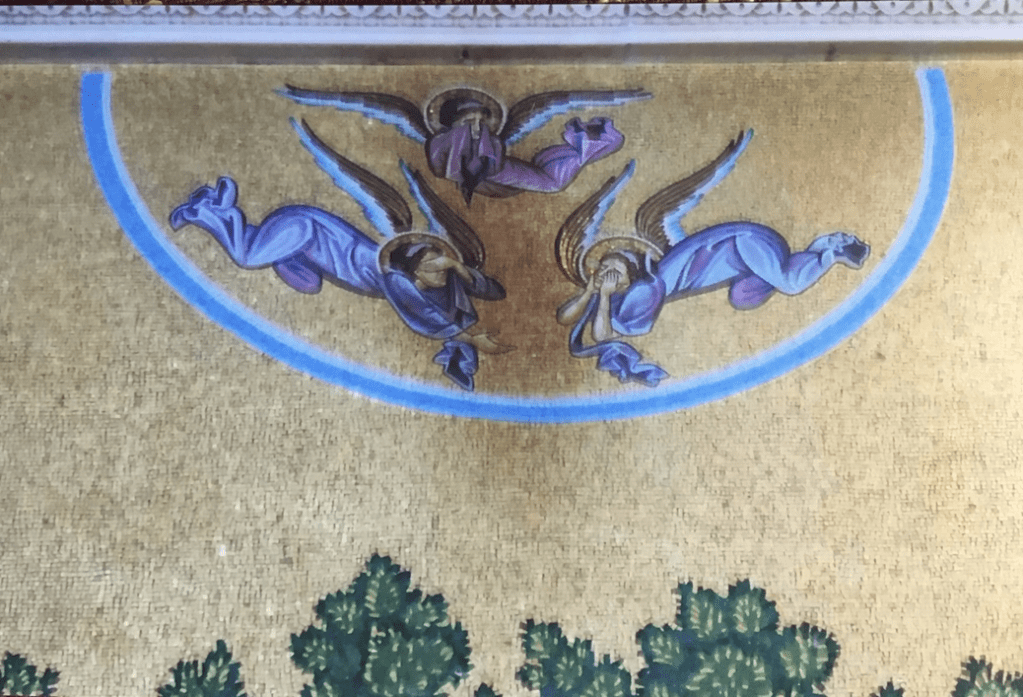
Jesus is taken down from the cross:
The words “Father, forgive them for they know not what they are doing” have been spoken. (Luke 23:34)

The words “It is finished” have been spoken to fulfill the scriptures. (John 19:30)
And the prayer “Father, into your hands I commend my spirit” has been cried. (Luke 23:46)
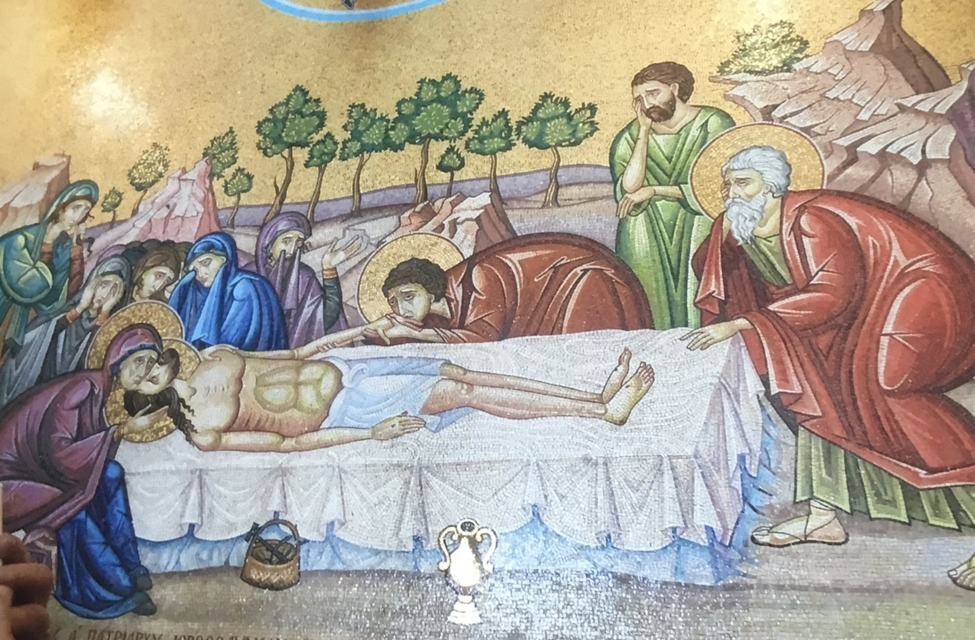

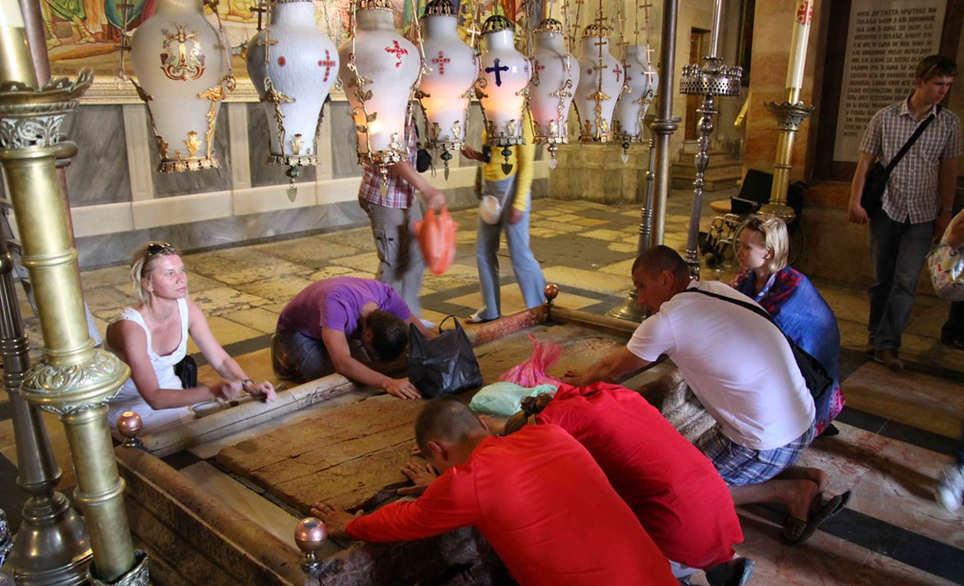
These mosaics are on an interior wall in front of the stone of anointing – the place where Jesus’ body was laid and quickly anointed as it was taken from the cross. That day in the Holy Sepulchre people were kneeling around the stone, praying and weeping. There was deep emotion reflecting the cries of vulnerable humanity heard across the ages.
Reflection:
Jesus was killed by the evil in the world. Jesus was not sent by God to be killed. Jesus took on human flesh to point humanity toward God, who is creator, and redeemer, loving us more than we can imagine – enough to forgive every nasty thing we do. This is the place where our lent journey leads us – to unconditional and all encompasing love.
Pause in your devotion now. Bow in prayer recalling power abuses seen in the world today. Pray Jesus’ prayer “Father, forgive them, (Father forgive me,) We don’t know what we are doing. Please release me from this burden of hatred and ego. Fill me with your love. Make me new and bring me to joyful thanksgiving that all people are forgiven through your grace. . Amen

Return to visit the Holy Sepulchre when you are able to spend time here. Peace be with you as we journey through Jesus’ life and death. May you be blessed as you prepare for the Holy Celebration and say the words: “Christ has died, Christ is risen, Christ will come again”, witnessing to what God is doing in our lives.
More about the Holy Sepelchre
One more Holy location in the Sepulchre is found in the largest part of the church. The Edicule, or shrine that encloses the tomb where Jesus was laid and from where he rose is protected by what looks like an elaborately decorated box – the size of a room within a room.
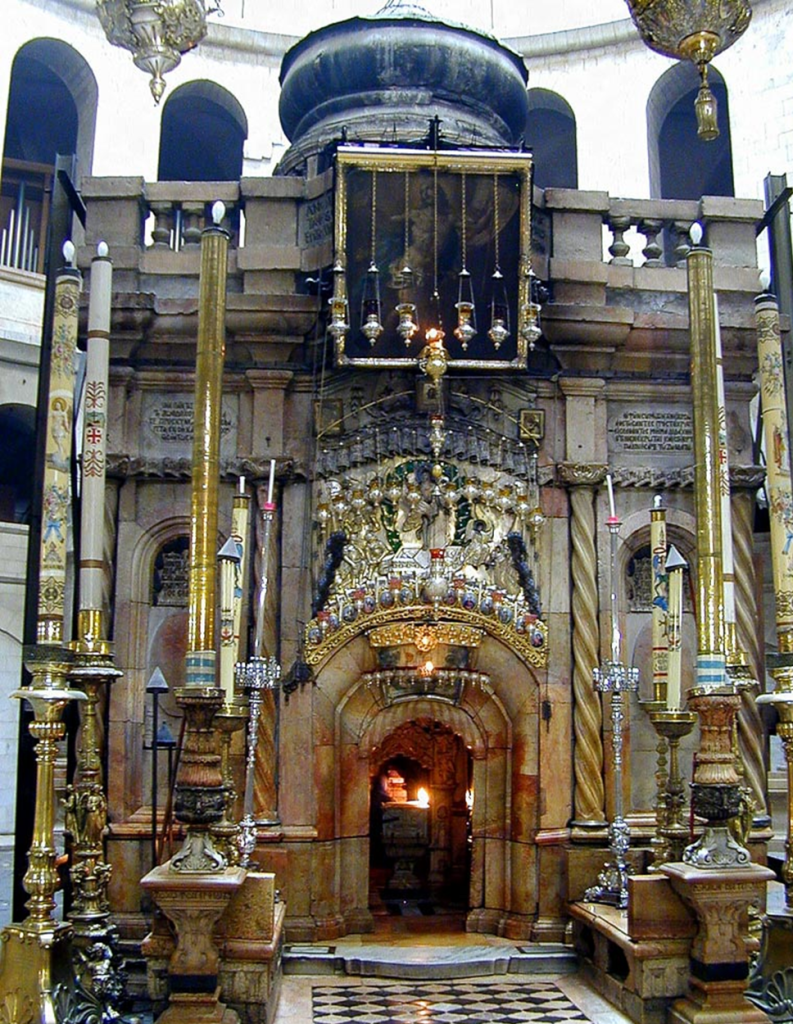
This structure preserves the location of Christ’s tomb. A clear history shows that this is the revered location of the tomb. When we visited, the Edicule was undergoing significant restoration, and as part of this work, the tomb was opened for the first time in centuries.
During that work, visitors were not able to access the Edicule, but as you can see from the photo of our group, people still crowded around to touch as near as they could, the spot where Jesus had been laid.

When Constantine converted the empire to Christianity, he had the church built over the spot and the Edicule constructed inside.
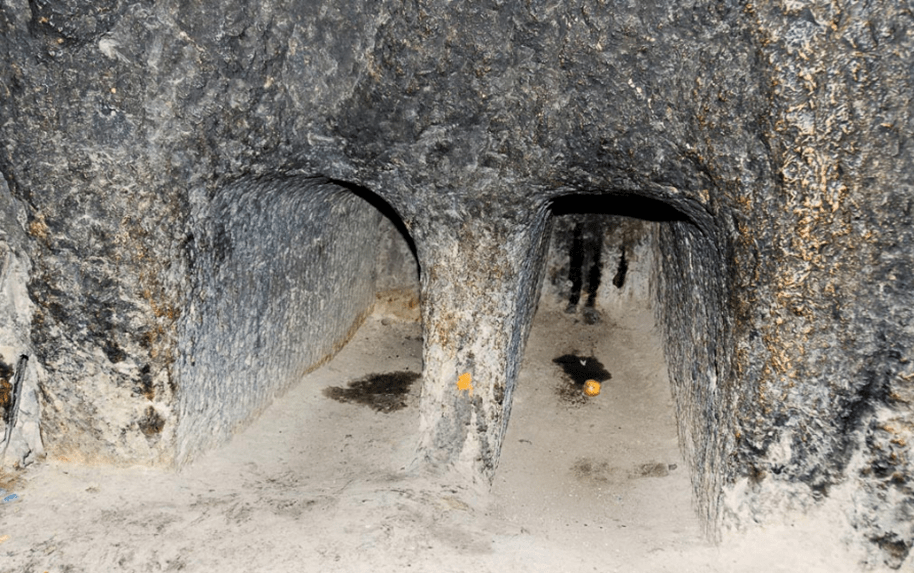
First century tomb
The best piece of evidence that the tomb of Jesus was in this area is the fact that other first-century tombs are still preserved inside the church. Called the “Tomb of Joseph of Arimathea,” these burial shafts (kokhim) are clearly from the time of Christ’s death and thus attest to some kind of burial ground in the area. Combined with the evidence from tradition, this church is most likely the true location of Christ’s death and burial. The picture below shows an empty tomb.
Stone of Anointing:
This significant religious artifact, also known as the Stone of Unction, is located within the church and is believed to be where Jesus’ body was anointed after being taken down from the cross.
Reflection and prayer:
Jesus was in the tomb for 3 days. As we observe the three Holy days, plan to carve some time for your own personal reflection.
Hold time to see how God fills open hands with the things we need – not material things, but things of God’s kingdom: Love, relationships, hope.
Reflect on the things which hold us prisoner and in fear – and turn them over to God so that our relationships and lives can be free from burdens of fear, control, and ego.
Remember our baptism promises, and God’s promise to be with us always. Hold this promise close to your heart.
Sit in contemplation regularly as Jesus did, going into nature and breathing in peace, God’s peace -which human minds cannot create on their own.
Most sincerely, give thanks to Jesus for opening the gateway to God’s presence, and his prayer pleading for God’s forgiveness for us all.
Form your prayer this day around these gifts of your Lenten journey.
Peace be with you until we gather together and cry “Christ is risen! Christ is risen indeed.”
Amen
Exterior view of the Church of the Holy Sepulchre

 finding Grace in Surprising Ways