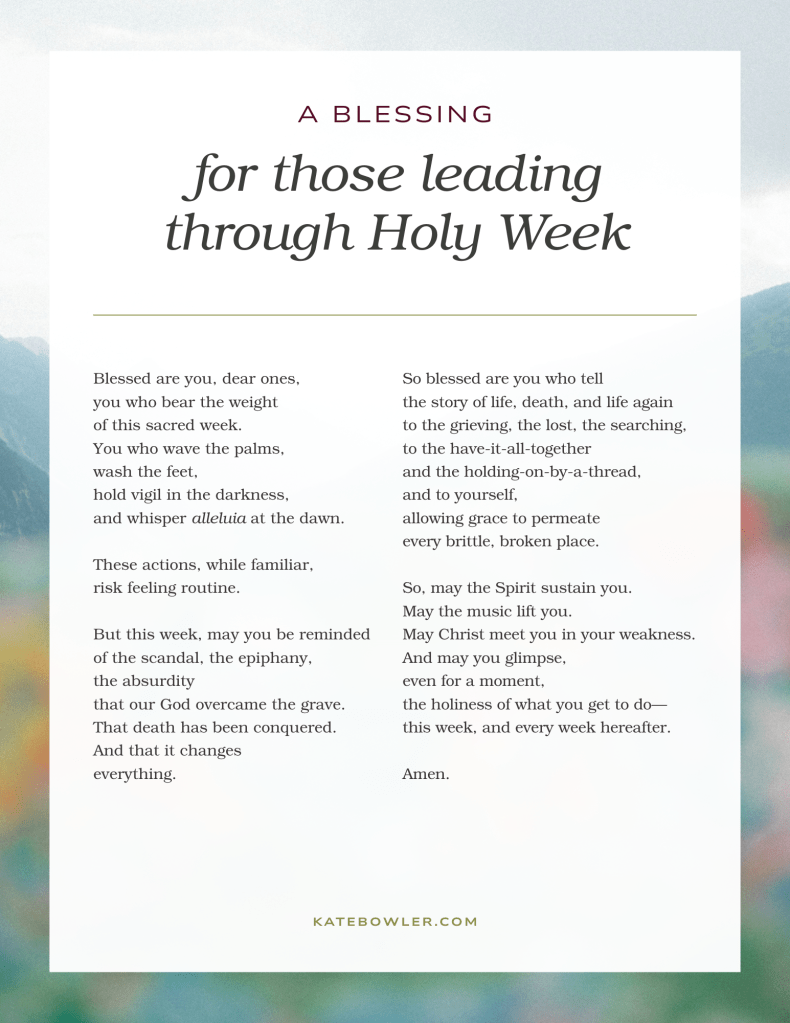
this is from a daily mailing I receive and I share it with you this week. Check out her web page if you wish. Receive this gift today. Be blessed this week.
Pastor Pam
Questions and ponderings
this is from a daily mailing I receive and I share it with you this week. Check out her web page if you wish. Receive this gift today. Be blessed this week.
Pastor Pam
Approaching a most sacred site in Jerusalem, we bow in prayer: Jesus, Remember me when you come into your kingdom. Jesus remember me, Amen
Today we make our final stop for this devotion series. We arrive at The Church of the Holy Sepulchre, a holiest of holy Christian sites, revered as the site of the tomb and Resurrection of Jesus Christ. The church was planned to enclose the site of both Golgotha and the nearby tomb where Jesus was laid.

We entered and our eyes adjusted from the bright sunlight to see a glowing mosaic in the dim light of the entrance. Slowly, we were wrapped in the golden highlights of a brilliant mosaic of our Lady of Sorrows.
As we contemplated the authenticity of the claim that the cross of Jesus was once in this spot, Bishop Pryce came up behind us and gently said “go and touch the place of the cross”.
In other words, we were there and he encouraged us to enter into the full experience. (Thank you Bishop!)

So we moved from the shimmering entrance, and stood in line, recalling the events of the day Jesus was crucified.
Inside the church is a rocky outcropping which marks the traditional place where the cross was placed. Archaeological excavations have demonstrated that this site was outside the city but close to one of its gates and thus would have been a used as a location for a crucifixion. Today this chapel is controlled by the Greek Orthodox Church.
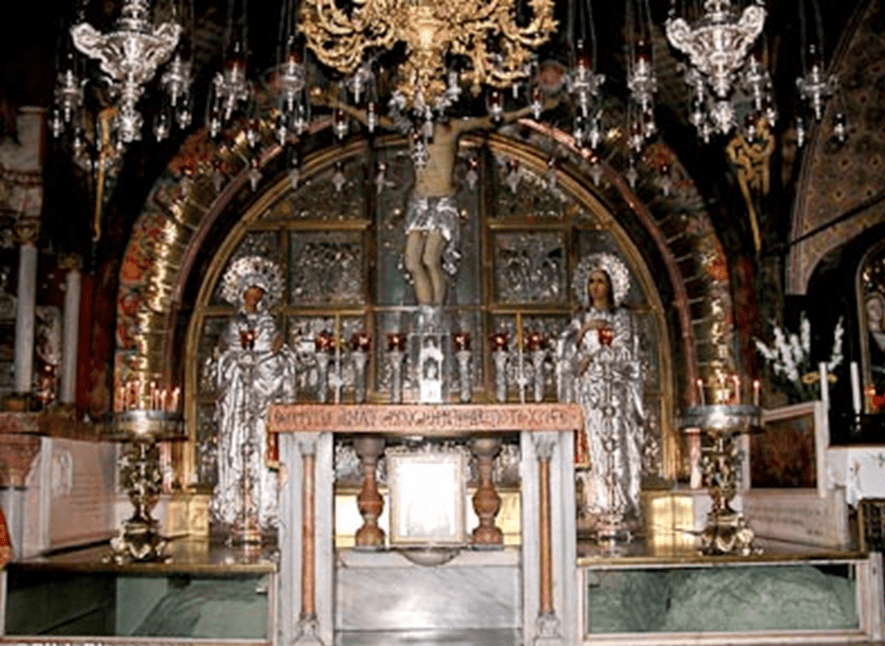
When my turn came, I knelt at the altar, and reached out my hand placing it into the crevice beneath the altar where Jesus’ cross had stood. The terrible cruelty of Jesus’ crucifixion became very real at that moment: Christ died at the hands of cruel and oppressive powers. From this place he had prayed: Father forgive them. Oh my heart!
I stood and slowly moved away from the place of the cross, wandering the chapels and thinking, until I came to the huge wall of mosaics.
Join me in looking at these pieces of art.
This is the hall of mosaics. The anointing stone is also here – the place where Jesus’ body was laid for quick anointing before being placed in the tomb.

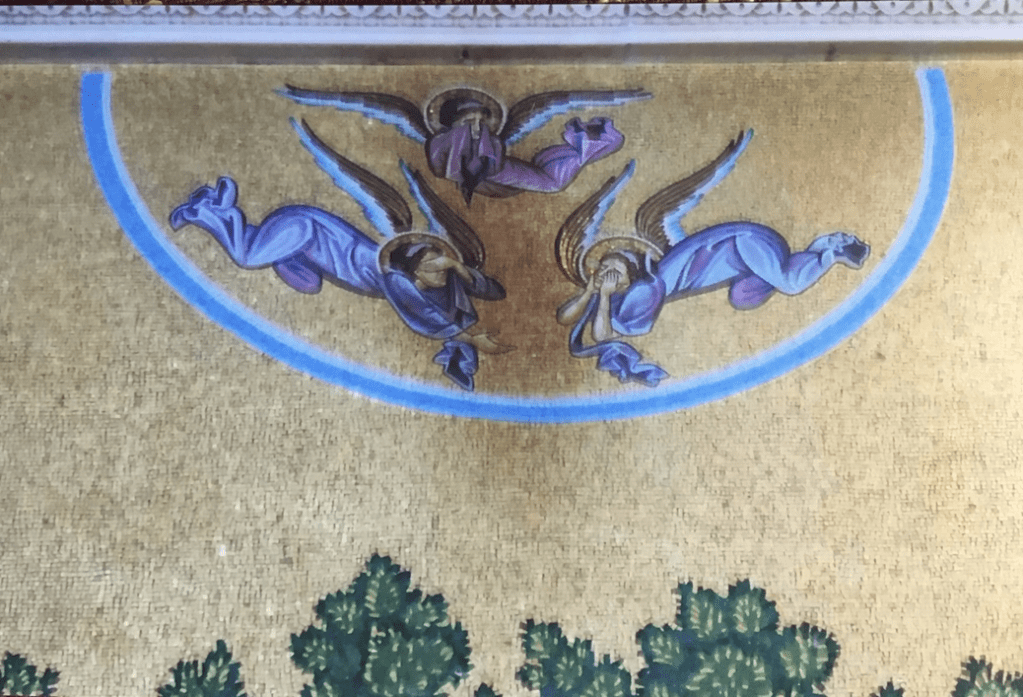
Mosaic image of anguished angels weeping at the cruelty in the world.
Jesus is taken down from the cross:
The words “Father, forgive them for they know not what they are doing” have been spoken. (Luke 23:34)

The words “It is finished” have been spoken to fulfill the scriptures. (John 19:30)
And the prayer “Father, into your hands I commend my spirit” has been cried. (Luke 23:46)
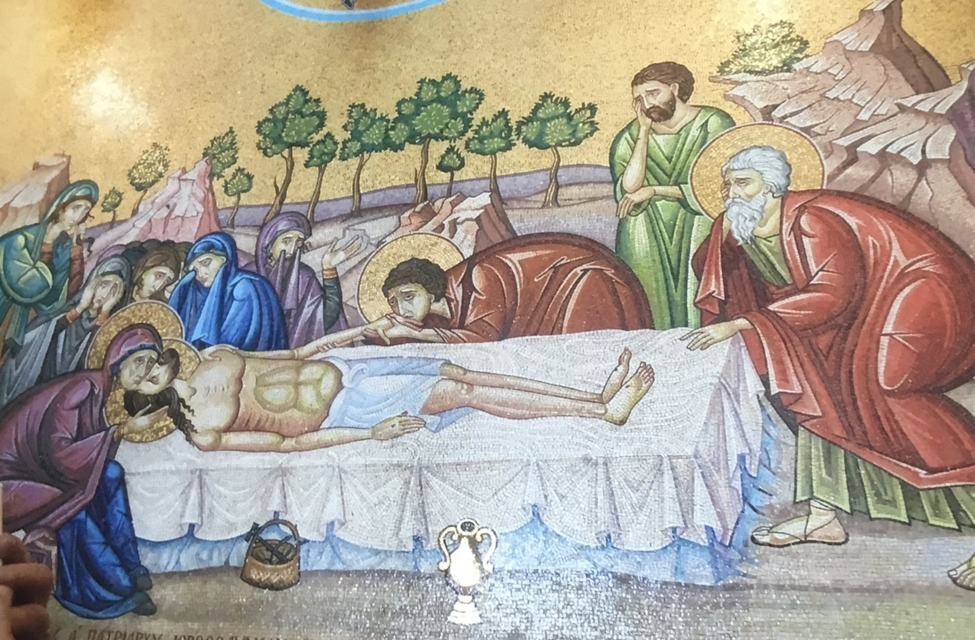

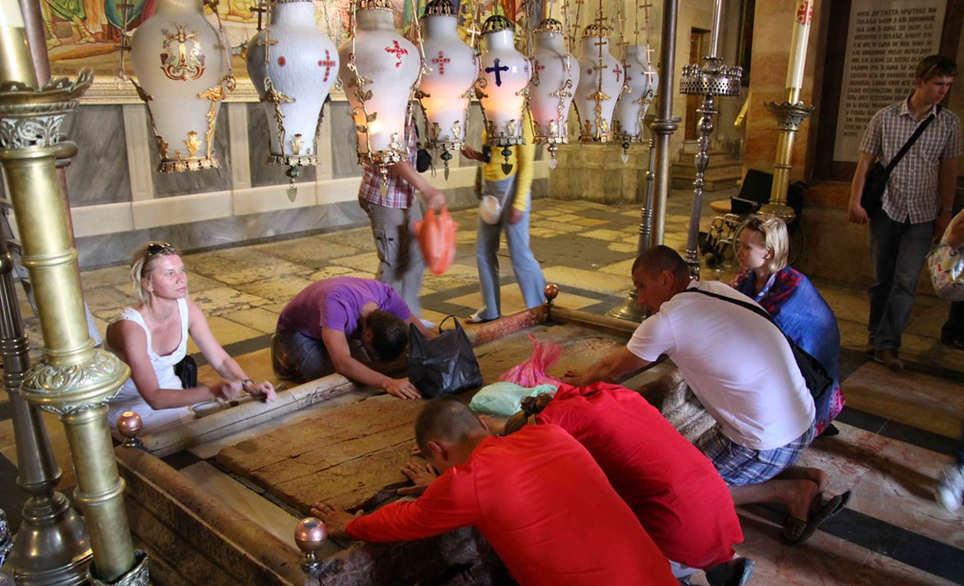
These mosaics are on an interior wall in front of the stone of anointing – the place where Jesus’ body was laid and quickly anointed as it was taken from the cross. That day in the Holy Sepulchre people were kneeling around the stone, praying and weeping. There was deep emotion reflecting the cries of vulnerable humanity heard across the ages.
Jesus was killed by the evil in the world. Jesus was not sent by God to be killed. Jesus took on human flesh to point humanity toward God, who is creator, and redeemer, loving us more than we can imagine – enough to forgive every nasty thing we do. This is the place where our lent journey leads us – to unconditional and all encompasing love.
Pause in your devotion now. Bow in prayer recalling power abuses seen in the world today. Pray Jesus’ prayer “Father, forgive them, (Father forgive me,) We don’t know what we are doing. Please release me from this burden of hatred and ego. Fill me with your love. Make me new and bring me to joyful thanksgiving that all people are forgiven through your grace. . Amen

Return to visit the Holy Sepulchre when you are able to spend time here. Peace be with you as we journey through Jesus’ life and death. May you be blessed as you prepare for the Holy Celebration and say the words: “Christ has died, Christ is risen, Christ will come again”, witnessing to what God is doing in our lives.
One more Holy location in the Sepulchre is found in the largest part of the church. The Edicule, or shrine that encloses the tomb where Jesus was laid and from where he rose is protected by what looks like an elaborately decorated box – the size of a room within a room.
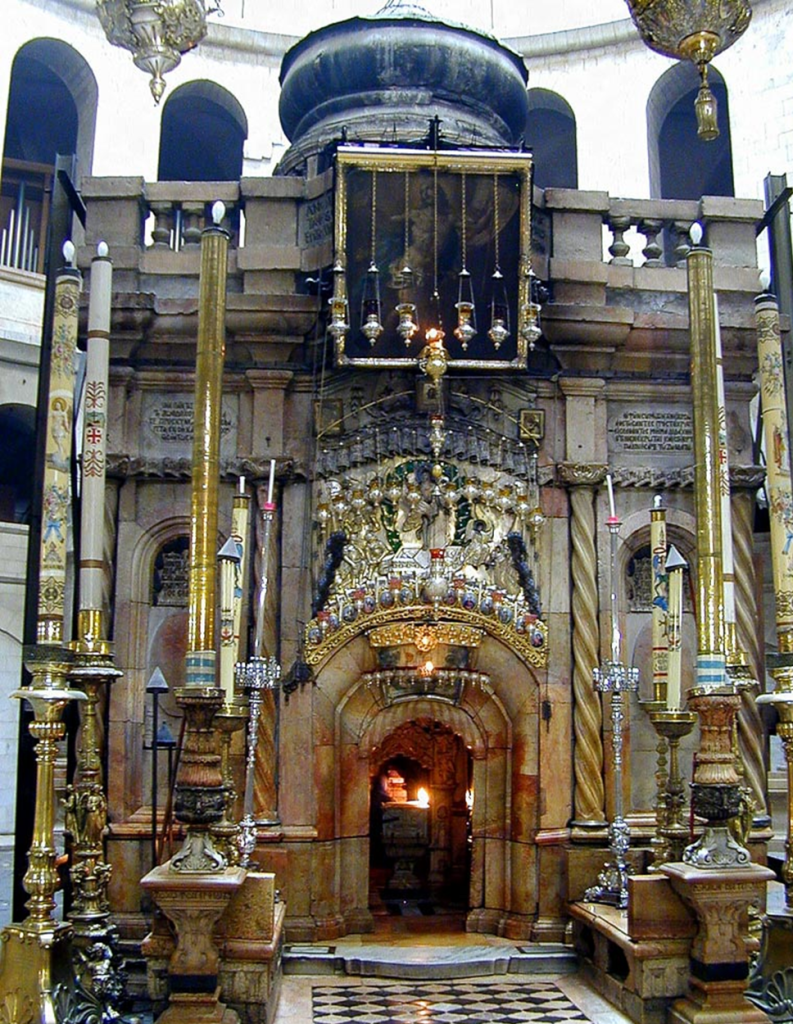
This structure preserves the location of Christ’s tomb. A clear history shows that this is the revered location of the tomb. When we visited, the Edicule was undergoing significant restoration, and as part of this work, the tomb was opened for the first time in centuries.
During that work, visitors were not able to access the Edicule, but as you can see from the photo of our group, people still crowded around to touch as near as they could, the spot where Jesus had been laid.

When Constantine converted the empire to Christianity, he had the church built over the spot and the Edicule constructed inside.
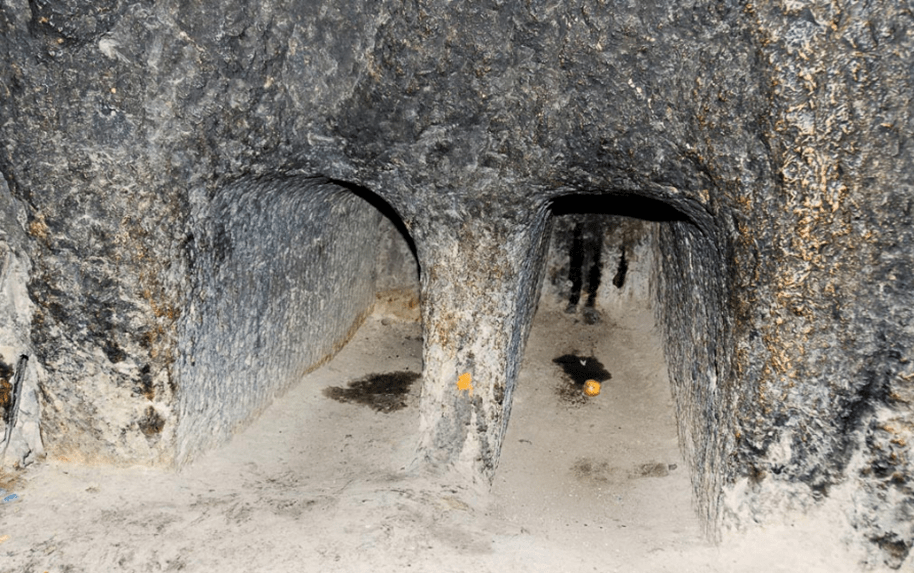
The best piece of evidence that the tomb of Jesus was in this area is the fact that other first-century tombs are still preserved inside the church. Called the “Tomb of Joseph of Arimathea,” these burial shafts (kokhim) are clearly from the time of Christ’s death and thus attest to some kind of burial ground in the area. Combined with the evidence from tradition, this church is most likely the true location of Christ’s death and burial. The picture below shows an empty tomb.
This significant religious artifact, also known as the Stone of Unction, is located within the church and is believed to be where Jesus’ body was anointed after being taken down from the cross.
Jesus was in the tomb for 3 days. As we observe the three Holy days, plan to carve some time for your own personal reflection.
Hold time to see how God fills open hands with the things we need – not material things, but things of God’s kingdom: Love, relationships, hope.
Reflect on the things which hold us prisoner and in fear – and turn them over to God so that our relationships and lives can be free from burdens of fear, control, and ego.
Remember our baptism promises, and God’s promise to be with us always. Hold this promise close to your heart.
Sit in contemplation regularly as Jesus did, going into nature and breathing in peace, God’s peace -which human minds cannot create on their own.
Most sincerely, give thanks to Jesus for opening the gateway to God’s presence, and his prayer pleading for God’s forgiveness for us all.
Form your prayer this day around these gifts of your Lenten journey.
Peace be with you until we gather together and cry “Christ is risen! Christ is risen indeed.”
Amen
Exterior view of the Church of the Holy Sepulchre

Lent is a Journey – from the wilderness to seeing how God touches our life.
A prayer for our journey: My Soul proclaims your greatness O Lord. We rejoice in your love for all people and creation. Be with us as we journey. Open our eyes and hearts to your presence in our life. Amen
Today we visit The Mount of Olives and sit under the ancient olive trees in the garden of Gethsemane.
My hope is to share with you the peace of this place where Jesus prayed, and yet, Jesus was deeply troubled that night. The world remains a place where people chose evil and greed, and seek power, acting without compassion.
I wish to share with you the care and time that it takes for Olive trees to grow, and produce the fine oil which Mary (no last name) used to honour and anoint Jesus. Judas criticised her action, but Jesus spoke to him. Perhaps that strengthened the resolve of Judas to harm Jesus. He later regretted that. The peace of God is pure. The peace of the world is fleeting.
The Mount of Olives is one of the oldest Biblical cultivations of olive groves, and some still remain in the Garden of Gethsemane. We were able to walk in the Garden.

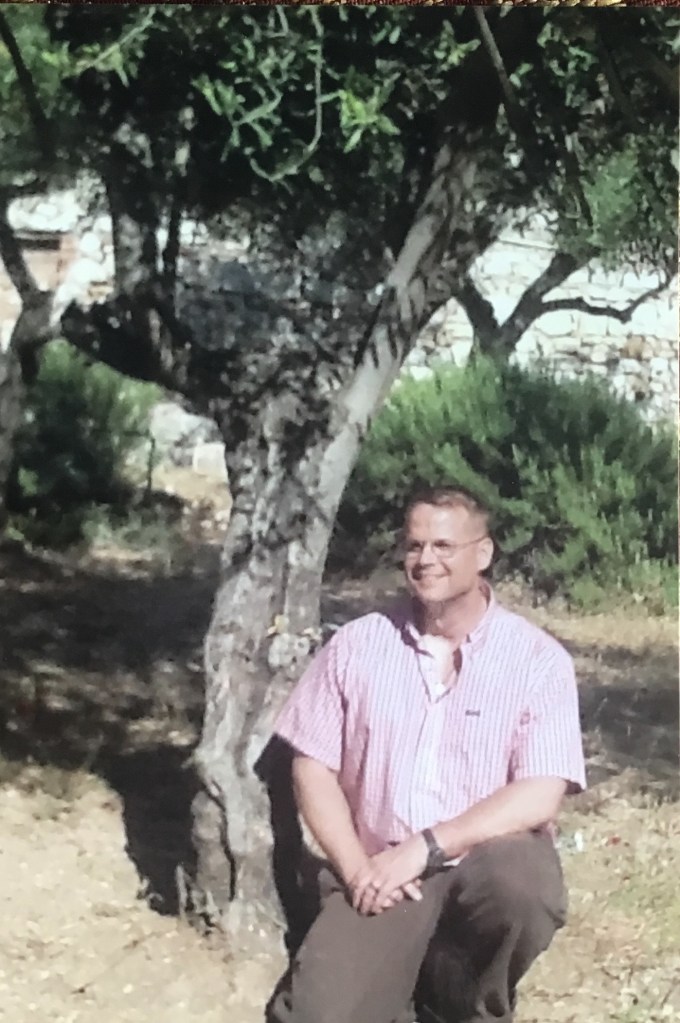
Our tour leader arranged for us to spend an hour in the Garden of Gethsemane and we instinctively separated to walk alone. It seemed the right way to be there. Of course, the grounds are looked after very lovingly, and perhaps it looked different than when Jesus found retreat there. In this time, the peace of the space was perfect. It did not seem important to take pictures during our time there, so I only have a few. When I say or hear the words “The peace which passes understanding” I think of this place, and immediately my stress and anxiety lowers. That same feeling can be found in places closer to home too, especially if one’s mind holds the words of God’s peace. Where do you retreat when you need space to sit and just breathe?
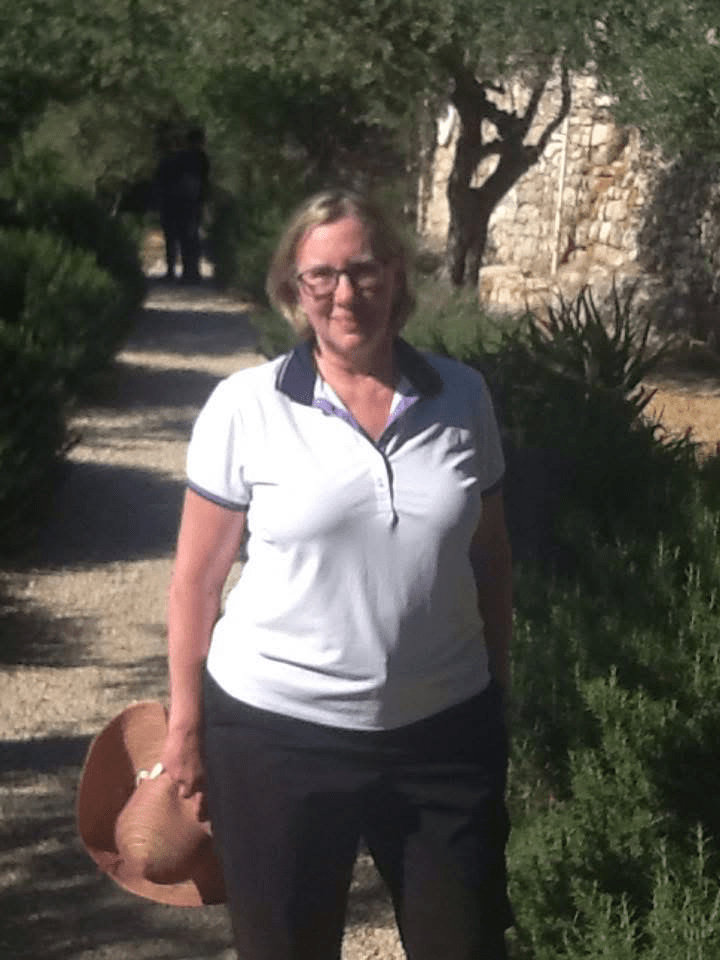
These are a few of my photos from the garden- myself in the first one and Pastor Jason in the second.
Biblical references to the Mount of Olives:
Jesus shares a meal with his disciples. Bread and wine is offered as the body and blood of Jesus. They sing the Passover hymn and go out to the Mount of Olives. (Matthew 26:26-31)
Before he is betrayed, Jesus takes three disciples with him as he goes to pray, because he is so very anguished. The peaceful garden lulls the disciples to sleep. (Matthew 26:36-46). When we give our worries and burdens to God, we too are able to sleep.
The events of Jesus’ arrest occur at the Mount of Olives and are recorded in three of the Gospels: (Matthew 26; Mark 11-14; Luke 19-22;)
John records the account of the woman accused of Adultery as happening on the Mount of Olives – (John 8) a story where the law of society is used to shame those who are already vulnerable. We do that – when we say “those people” or “someone should…” suggesting that we know what should happen and are therefore superior. (“shame on them” is the unspoken message) The way of Christ is not to shame, but to lift up those who are vulnerable or weak.

The Olive branch is a symbol of peace.
Reflection question or thought: We seek peace in our life, we pray for peace and sometimes we do actually know the joy of living in peace. Too often, however, we find ourselves lacking in compassion, criticizing like Judas- taking the moral high ground, or being complacent about loving Jesus, maybe even falling asleep/taking Jesus for granted – just as the disciples did.
These traits hurt our heart when we think about them afterwards, and that is good. There is hope for us. These are the things that the refining fire of God will purify, and our true generous and loving soul will be returned to God: Ashes to ashes, dust to dust.
Facing the truth about ourselves is hard. Facing the grace of God who loves, and forgives is hard too, it makes me weep because I deserve nothing. God forgives us and holds us in love.
Pause here with a prayer for God to create in us a clean heart and to renew a right spirit within us.
Return to this devotion when and if you have time. Read about olive trees, and the significant sites on the Mount of Olives.

Olive Groves: One of the oldest Biblical olive groves that covered the mountain slopes of the Judean Mountains still exists today. An olive tree does not produce fruit until it is at least 5 years old, but then it can produce for thousands of years if properly pruned and cared for.

Fruit grows on new growth from the previous year, so pruning needs to protect those branches. The fruit ripens best on a tree that is pruned so “a bird can fly through the centre” – meaning that pruning allows the light to filter onto the fruit.
The trees are not able to survive cold temperatures, but the root system of an olive grove is very strong. Even after trees are cut down, sprouts come forth around the stump, and new trees grow.
The symbolism of the olive tree is ancient too – branches represent peace and abundance and are presented to deities and powerful people as signs of purification and blessing. The oil continues to be used in many religious ceremonies and is considered sacred. Olive production is a livelihood for many Palestinian families.

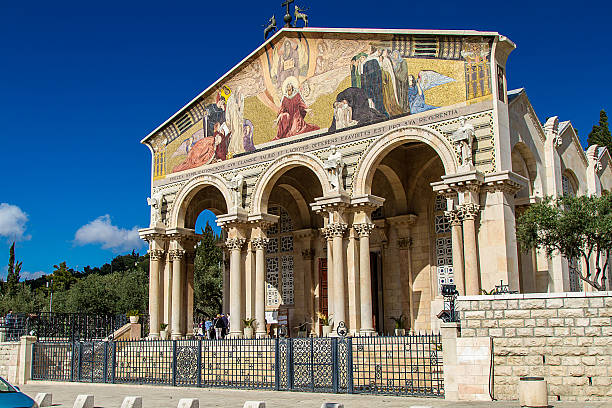
In addition to the Garden of Gethsemane, the Church of All Nations stands on the Mount of Olives. It is a Roman Catholic church located next to the Garden of Gethsemane. It is built over the rock Jesus is said to have prayed on in agony before he was betrayed by Judas. Often called the Church of Agony, it is built on the foundation of 2 earlier buildings: a 4th century Basilica and a 12th century Crusader chapel. The funds for the building came from 12 different countries, and the coat of arms of each country – including Canada- are displayed.
The Church encloses the rock of agony, seen in the picture below. The inscriptions above the columns at the front door are two scripture passages:
(Luke 22:43–44) “And being in agony he prayed more earnestly; and his sweat became like great drops of blood falling down to the ground.”
(Matthew 26:42b) “My Father, if this cup cannot pass unless I drink it, your will be done.”
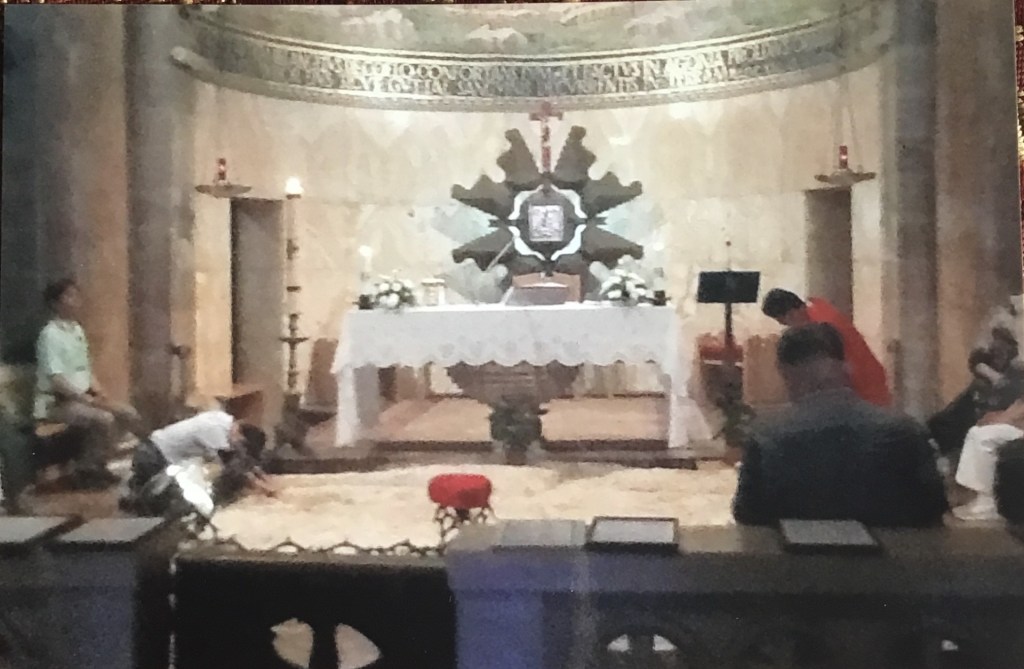

The day we spent on the Mount of Olives ended with communion in a shaded area, reserved for our use. Sharing the bread and wine at the end of the day left us with profound gratitude for Jesus who met evil and death and conquered them. We went on our way, touched with deep faith for God’s promised redemption.


My prayer is for the love of Christ to live in us, changing the world and changing our lives. Amen
pastor Pam
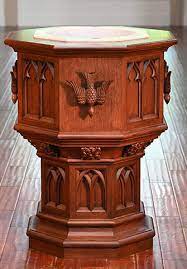
Lent is a Journey. Our journey of faith circles the baptismal font, and Lutherans LOVE to “liturgize” these events!
One of the liturgies of thanksgiving for baptism declares “we remember the waters of Jesus – baptized in the Jordan River, calming the Sea of Galilee, drinking from Jacob’s well, healing at the pool of Bethesda, washing the feet of his disciples”. We will visit some of these places this week.
On the last day of the festival, the great day, while Jesus was standing there, he cried out, “Let anyone who is thirsty come to me” (John 7:37)
A prayer: God of flowing waters, fill us with longing for you as one in the desert longs for quenching water. And satisfied let your love be an ever flowing stream through us to a thirsty world. Amen
We arrive at the Jordan River and the first sight is breathtaking – branches of palm trees waving in a lovely breeze on a very hot day. A steep pathway leads to individual areas for groups to gather and celebrate baptism or baptism renewal.
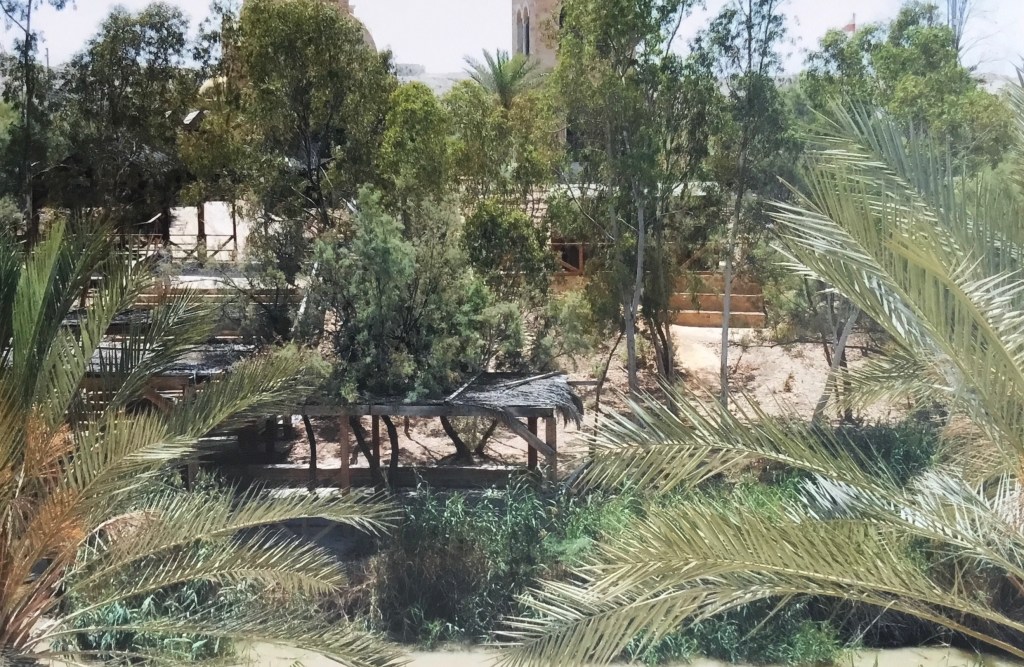
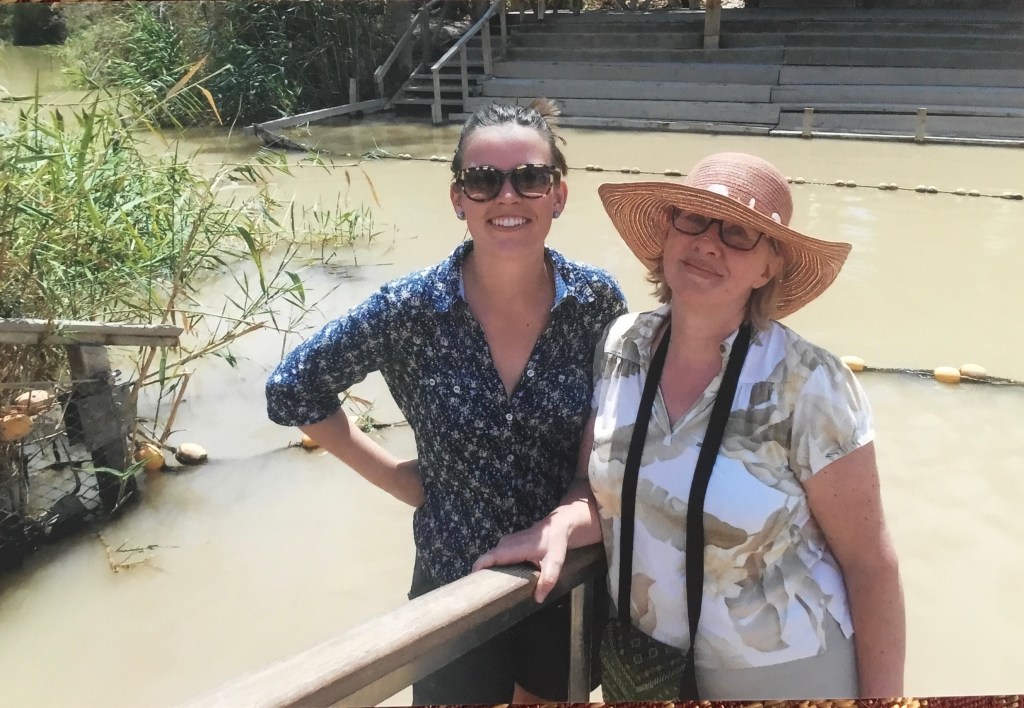
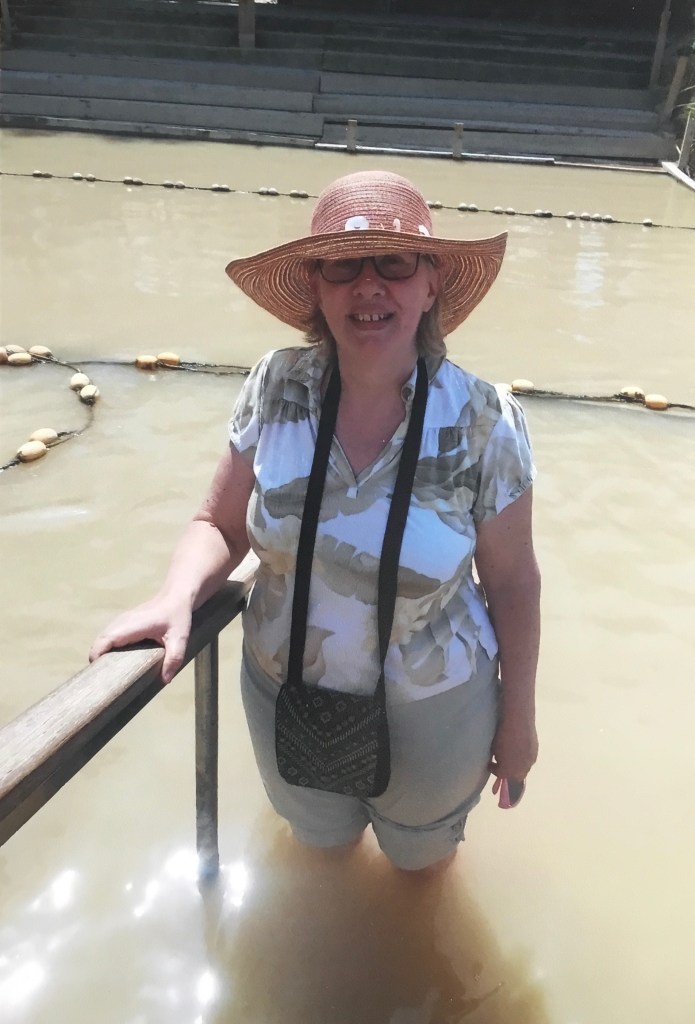
A few of us removed our shoes and moved into the water. I was thankful for wooden steps which continued under water, because I’m squeamish about stepping on the bottom of lakes or rivers. The water was a clay colour, definitely not clear. It was not cold, nor did it have a strong current.
This is our opportunity to renew our baptism promises while standing (on a step) in the Jordan River. It was meaningful to acknowledge our belief that Jesus is the Son of God. Doing that in the place where those words were first said was powerful.
Biblical references to Water:
God claims us through water of baptism – And when Jesus had been baptized, just as he came up from the water, suddenly the heavens were opened to him and he saw God’s Spirit descending like a dove and alighting on him. 17 And a voice from the heavens said, “This is my Son, the Beloved,[a] with whom I am well pleased.” (Matthew 3:16-17; Mark 1:10-11; Luke 3:21-22;)
Jesus revealed God’s unconditional love through water –At Jacob’s well Jesus speaks to a Samaritan woman. It was an unusual act for a man to speak directly with a woman, especially a woman who was considered to be a foreigner: Jesus answered her, “If you knew the gift of God and who it is that is saying to you, ‘Give me a drink,’ you would have asked him, and he would have given you living water.” (John 4:10)
Through water God’s love is given to everyone – The story continues with marvelous developments: Many Samaritans from that city believed in him because of the woman’s testimony, “He told me everything I have ever done.” (John 4:11)
Reflection:
Water is vital to our health. It plays a key role in all of our body’s functions, including bringing nutrients to cells, getting rid of wastes, protecting joints and organs, and maintaining body temperature. Does thinking of Jesus as necessary as the water we need to live and grow and to maintain our temperature/attitude change the importance we give to having Jesus part of our every day?

Prayer for our journey: God of refreshing waters, cleanse us, calm us, heal us and make us new in your loving grace. Remove the burden of our mistakes; calm us from fear of things that are not familiar to us; satisfy our thirst to be held in your love. Heal the hurts we are not able to release on our own. We open our hands to you in trust. Amen
Pause in your devotions now if you wish, or continue on to see more waters of Jesus.
More about Waters of Jesus
The Jordan River is a unique waterway – water flows into the Sea of Galilee and the Jordan River basin from rain runoff flowing down from the surrounding hills. This is why the water is clay coloured and not clear. It carries sediment and soil from the land. The water flows through the valley and to the Dead Sea.
It is a unique water system which does not flow into the ocean. (If you are a word collector, it is called an Endorheic waterway.)
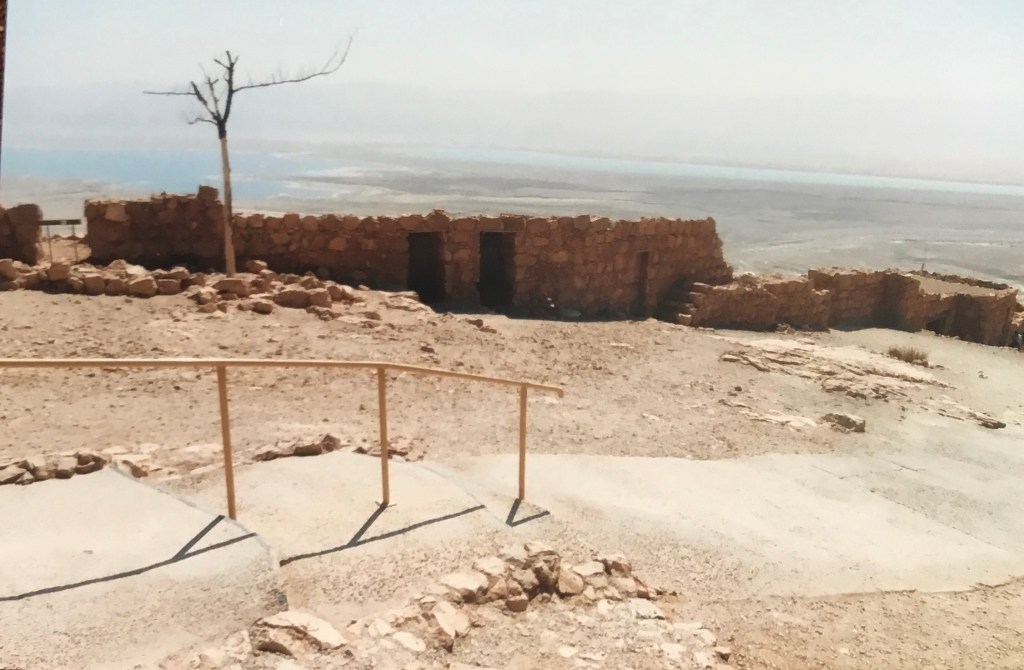
The minerals from the land are eventually deposited in the Dead Sea as the water evaporates. Hundreds of centuries of evaporation has increased the salt content of the Dead Sea. We were able to experience the weird buoyancy of that water.
The photo below is the 2017 view of The Dead Sea from the mountain top fortress of Masada. The Dead Sea is seen on the horizon.
Jacob’s well:
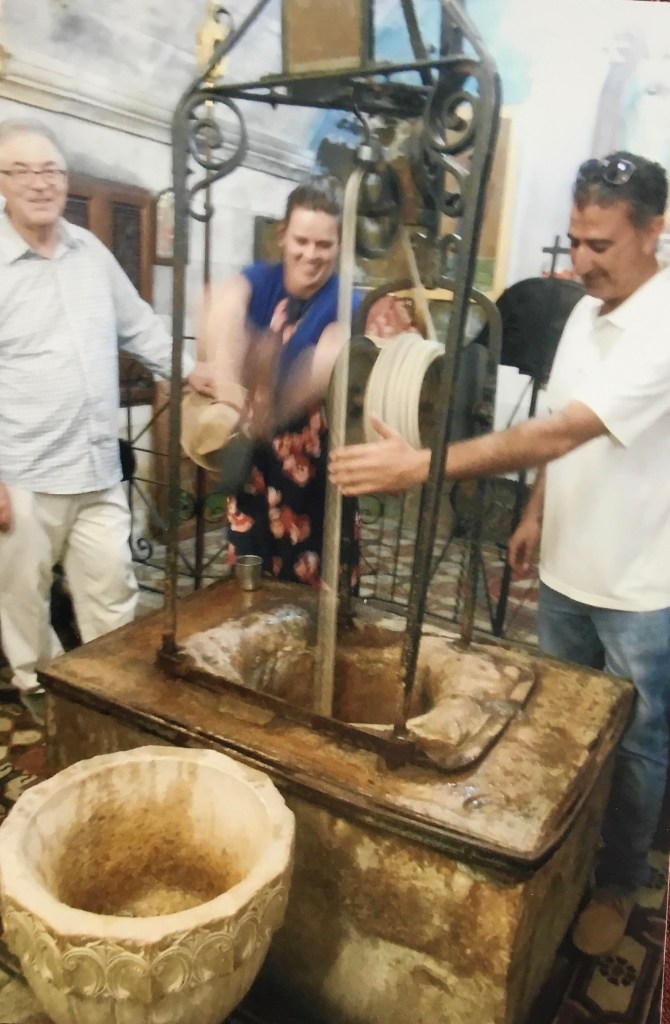
Located in the land of Shechem, on what today is the West Bank. This is known as the place where Jesus encountered the Samaritan woman and asked her for a drink of water. He then told her everything she wanted to hide about her life.
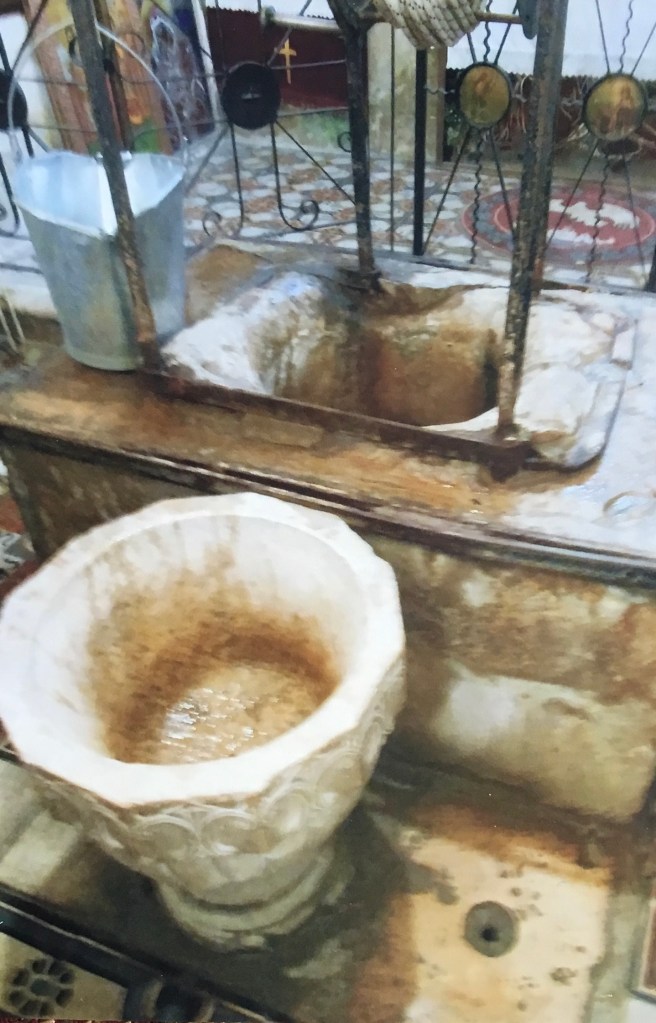
We sometimes pretend that we are different than we truly are, but Jesus knows us to the depths of our joy and despair. There is no need for pretenses. This is an endless source of truth, just as the well, -dug in the time of Jacob- is an endless source of clean water –still to this day.
The well is protected in a Greek Orthodox Convent, and guarded by Greek Orthodox priests. When we visited, one of the priests told us that his predecessor had been killed on the job when bandits came in and shot him.
The Bethesda pool:
The pool at Bethesda is recorded in scripture as healing water. The first person in the pool after “the angels stirred the water” was healed. Jesus saw a man who had been there for 38 years who could not get into the pool without help. Jesus compassion healed the man to the protest of religious leaders who chastised Jesus for breaking the Sabbath. (John 5)
When we visited the pool, we saw an archeological site – ruins and the barest outline of anything resembling the story in the gospel of John (5:2) We stood in the full sun, and we could appreciate that the people waiting for healing had shaded, safe places – porticoes – to sit while they waited.

It was common to build on existing structures. Earthquakes and waring destruction leveled many historical sites, and new buildings were erected on those spaces. That is what happened around the pool of Bethesda. In archaeological digs conducted in the 19th century a large tank was discovered, which was thought to be the Pool of Bethesda.
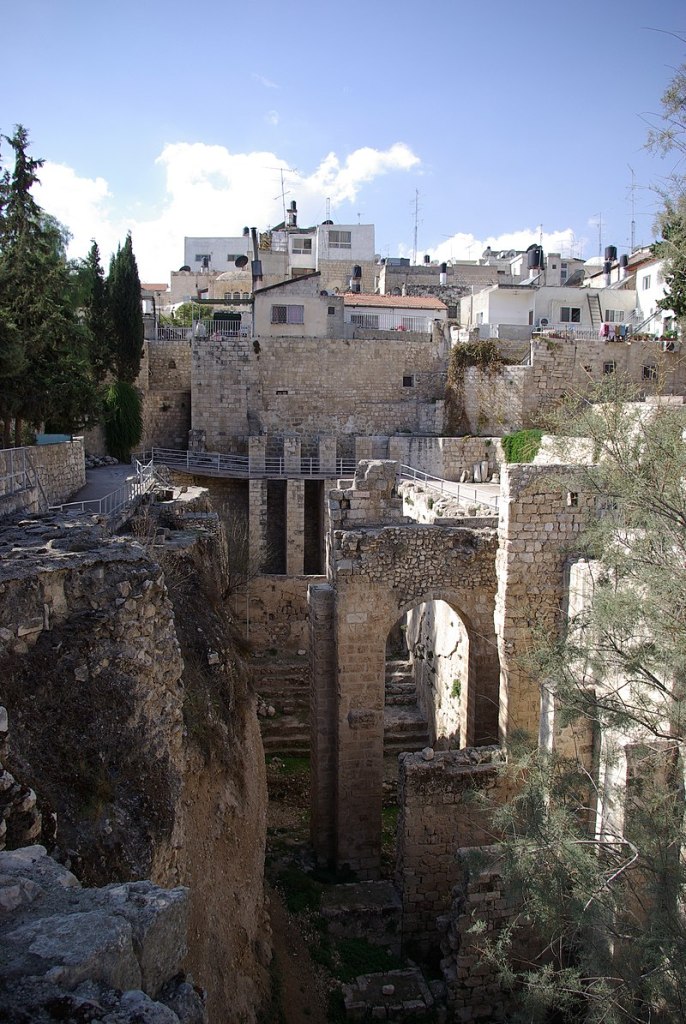
Further archaeological excavation in the area, in 1964, uncovered the remains of the Byzantine and Crusader churches, Hadrian’s Temple of Asclepius and Serapis, the small healing pools, the second of the two large pools, and the dam between them. It was discovered that the Byzantine church had been built in the very heart of Hadrian’s temple and contained the healing pools
To this day, there is no explanation of what ‘stirred’ the waters and why people were healed.
This map shows the archeological excavation of the pool area. the description at the bottom of the map is enlarged for easier reading.

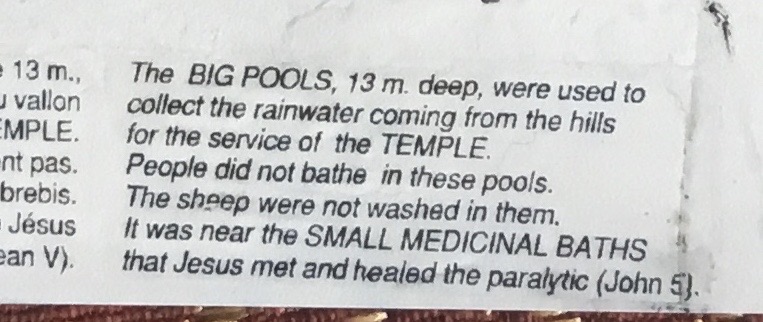
We hear Jesus say, “I will give you living water and you will never thirst” and we know that we are loved just as God made us: skin colour, gender and sexual orientation, mistakes and successes, all are known.
Jesus interacts with water in many places and ways.
His first miracle used water and turned it to wine to teach us of God’s abundant generosity.
His final act before his passion and crucifixion used water to show his friends how to humbly serve one another by simply washing their feet.
As we journey through Lent we give thanks for the living water of God’s grace which frees us from the things we want to hide, and allows our lives to unfold in the fullest and most meaningful way as God intended. Praise be to God.
Let us pray, Create in me a clean heart o God and renew a right spirit within me, a spirit of knowledge of your presence, and the joy of your loving grace, flowing like water through our lives and the lives of all who we witness to. Amen
service begins at 7:30
Topic: Maundy Thursday
Time: Apr 17, 2025 07:30 PM Eastern Time (US and Canada)
Join Zoom Meeting
https://us02web.zoom.us/j/87214937912?pwd=ETjgxmtCX6hymR2ZTigXoMULZFRSuJ.1
Meeting ID: 872 1493 7912
Passcode: 130869
Pamela McNeil is inviting you to a scheduled Zoom meeting
Topic: Sunday Worship
Time: Apr 6, 2025 10:00 AM Eastern Time (US and Canada)
Every week on Sun, until Jun 29, 2025, 13 occurrence(s)
Join Zoom Meeting
https://us02web.zoom.us/j/81965844449?pwd=JcGFceYgGLFcPuLcCkSGJa7gbL8xFb.1
Meeting ID: 819 6584 4449
Passcode: 703662
Dial by your location
• +1 438 809 7799 Canada
• +1 587 328 1099 Canada
• +1 647 374 4685 Canada
• +1 647 558 0588 Canada
• +1 778 907 2071 Canada
• +1 780 666 0144 Canada
• +1 204 272 7920 Canada
Meeting ID: 819 6584 4449
Passcode: 703662
Lent is a journey, returning to God amidst the hectic, frivolous, important events of our lives. Lent is a journey returning to God who gives us peace, stillness and comfort, whose name is written on our hearts.
God of graciousness and might, you are present in every moment of our lives, from the smallest corner to the greatest event. The sun does not rise nor does the moon shine without your command. Help us to call on you, and to trust your care. In Jesus name we pray. Amen
The Sea of Galilee is mentioned frequently in the New Testament gospels. It is here that Jesus’ disciples and followers witnessed Jesus as the son of God, leading them and us in faith and trust to God. Let our prayer this week be for our faith and trust to be strengthened as we journey through Lent.
Galilee is located about 150 KM north of Jerusalem and is the area surrounding the Sea of Galilee. This is the site of the major portion of Jesus’ ministry. He was a Nazarene, (from Nazareth) a place located in the south west part of Galilee.
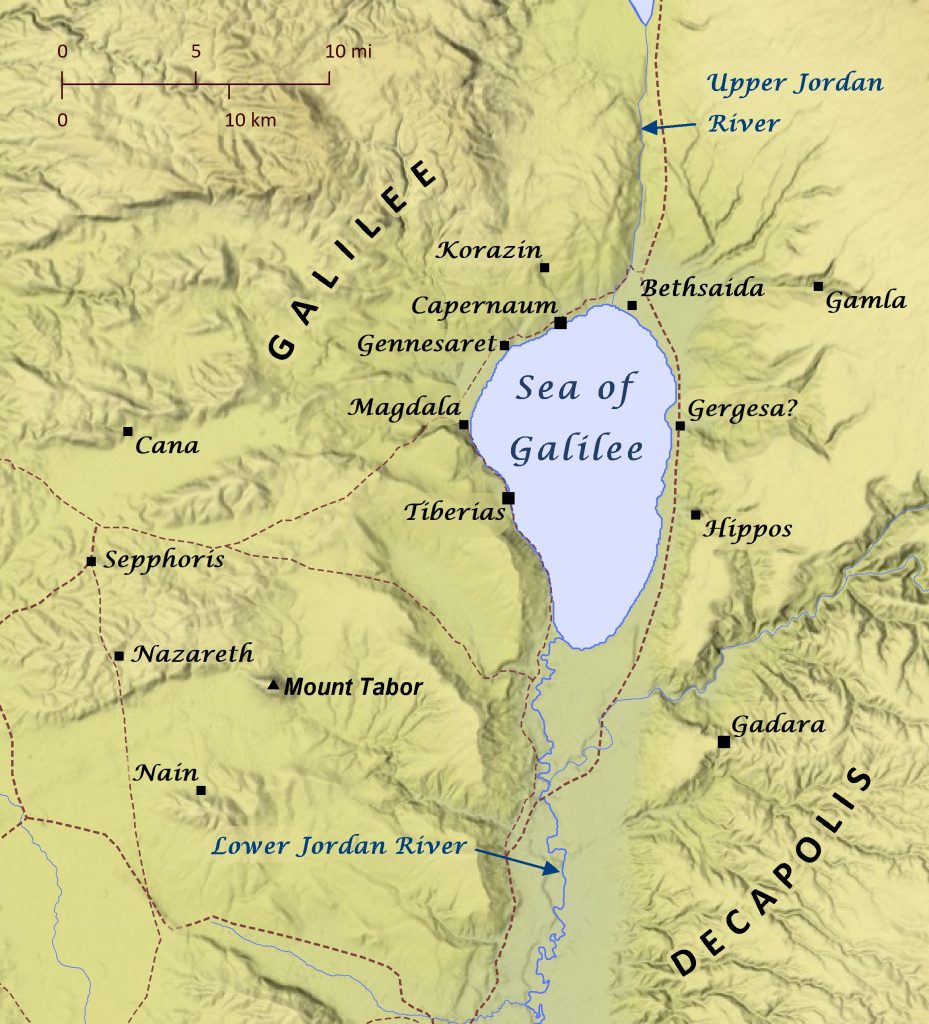
This body of fresh water has been known by many names throughout history: Sea of Tiberius; Lake of Gennesaret; or simply the Lake or the Sea. It lies about 700 feet below sea level, and reaches a maximum depth of 150 feet. It is about 8 miles long, and about 32 miles around.

Because it is surrounded by high hills, abrupt temperature and wind shifts cause violent and sudden storms on the water. We were able to venture out in a chartered boat, but did not go too far from shore.

Scripture references to the Sea of Galilee: Jesus calls his first disciples on the shore of Galilee– a story of amazing trust and faith. The first disciples, Simon Peter and Andrew fill their boats with fish and then leave to follow Jesus. (Matthew 4:18; Mark 1:16)
Jesus calms the storm: Crossing the Sea a storm suddenly came up and the disciples were terrified. In their fear they called to Jesus who woke and commanded the storm to be still. An account of the power of Jesus through God, so even the wind and the seas obey him! (Matthew 8:26)
Feeding the multitudes: Each of the books of the Gospel have one or two versions of this miracle where thousands of people were fed from a meagre supply of food. (Matthew 14 and 15; Mark 6 and 8; Luke 9 and John 6)
We pray “Give us our daily bread” but do we really believe that the food comes from God?
Prayer: let my prayer rise up in faith and trust oh Lord. Give us our daily bread and make us truly thankful. Amen
Pause in your devotions here if you wish, or you may continue on to read more about the Sea and area of Galilee.
The sea of Galilee is fed by water from the Jordan River, and then it flows into the dead sea. In Bible times it was an important source of food and employment for the people of the area, the heart of a viable fishing industry.
A discovery in 1986 of an ancient Galilean fishing boat from the first century was an historically significant find. The boat, 27 ft. long, and 7.5 ft. wide with a preserved height of 4.3 ft. was found by two brothers, Moshe and Yuval Lufan, during a drought when the water level in the sea receded.

The task of excavating the boat from the mud was conducted by an archaeological team and Israel Antiquities Authority. Care was taken to work quickly without damaging the boat before the water level rose again. The boat was found to be the type that was row-able, with four staggered rowers, and also had a mast allowing the fishermen to sail the boat.
This find is important to Christians because this was the sort of boat used by Jesus and his disciples, several of whom were fishermen. Boats such as this played a large role in Jesus’ life and ministry, and are mentioned 50 times in the Gospels, though there is no evidence connecting the excavated Sea of Galilee Boat itself directly to Jesus or his disciples.
The Seminary class was able to see this archaeological find. It is currently on display at the Yigal Allon Museum in Kibbutz Ginosar, Israel, located on the shores of the Sea of Galilee where it was discovered.
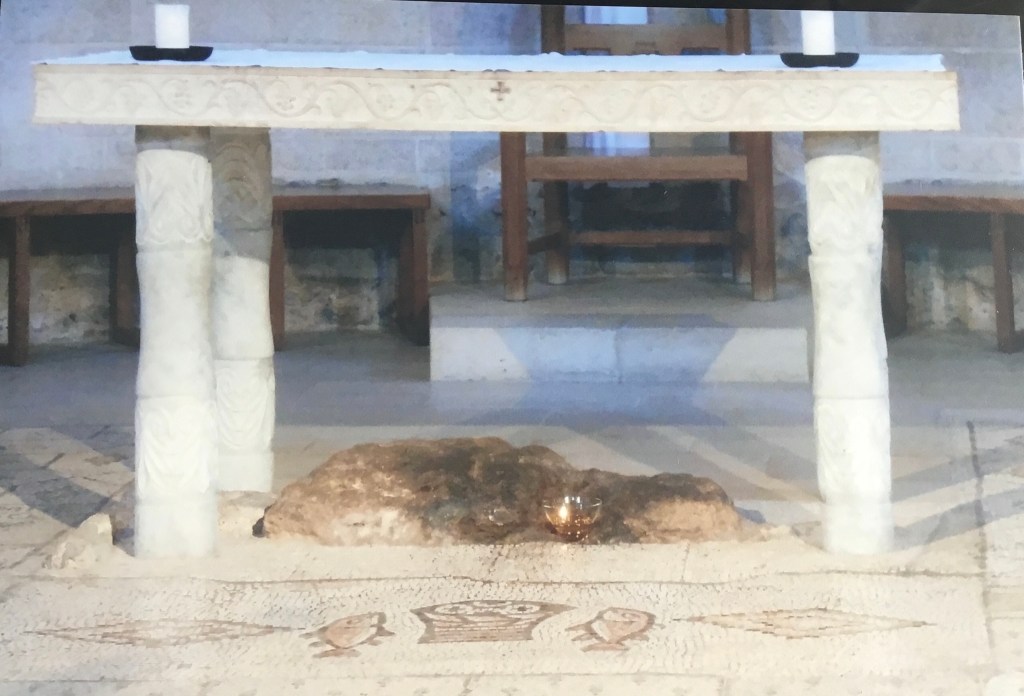
Another event, The feeding of the 5000 is remembered along the banks of the Sea of Galilee. A church is built on the site of the miracle of the multiplication. Inside, a simple altar protects the stone on which Jesus is thought to have placed the loaves and fishes to bless them. Beautiful mosaics of loaves and fishes appear on the floor at the altar.


Visiting these locations brings the ministry of Jesus alive for us. Feeling the fear of the disciples as we look at the remnants of a similar fishing boat stirs our fear of the unknown. The hunger of those who followed Jesus and were fed on the sea shore alerts us to the hunger we see around us. In all these things, we turn to God for guidance and strength.
Let this be our prayer for our journey this week: create in me a clean heart Oh God, and renew a right spirit within me, a spirit of Trust in God’s grace and favour. Amen
I
But those who wait upon the LORD will renew their strength; they will mount up with wings like eagles; they will run and not grow weary, they will walk and not faint. (Isaiah 40:31)
Our journey today looks at a city that is home to just about every nationality and culture in the world. It brings us face to face with a gentle look at our prejudices as we share food, practice our faith, and be neighbour to each other. Blessings as you engage in this work.
During Lent we read of Jesus turning his face toward Jerusalem to complete the task set before him. The Holy places in this city are remarkable in that they still exist. The most prominent site is the Temple in Jerusalem. We were able to climb the steps leading to the temple. This is the only places in Jerusalem that it is known for certain Jesus walked.

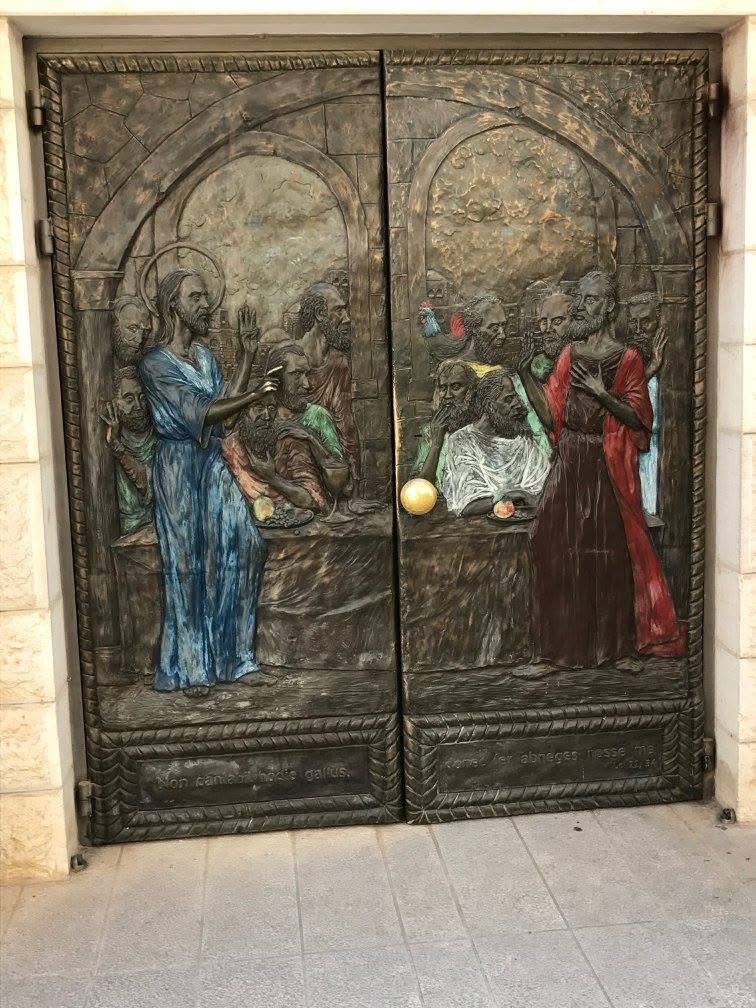
We also walked the way of sorrow, the Via Dolorosa which is the street it is believed that Jesus walked on the way to the cross. We saw places he might have placed his hand as he rested, where he fell, and where he met significant people face to face. Along the way, there is a large door carved with the image of Peter and the cock crowing. The Via Dolorosa ends at the Church of the Holy Sepulchre. It is an emotion filled walk.
Jerusalem is built between two hills in the Kedron Valley. We entered the city on foot, walking from the hilltop opposite Herod’s palace. Today, much of the hillside holds cemeteries, Muslim and Jewish, which are in turn torn apart, depending on who rules in that time period.
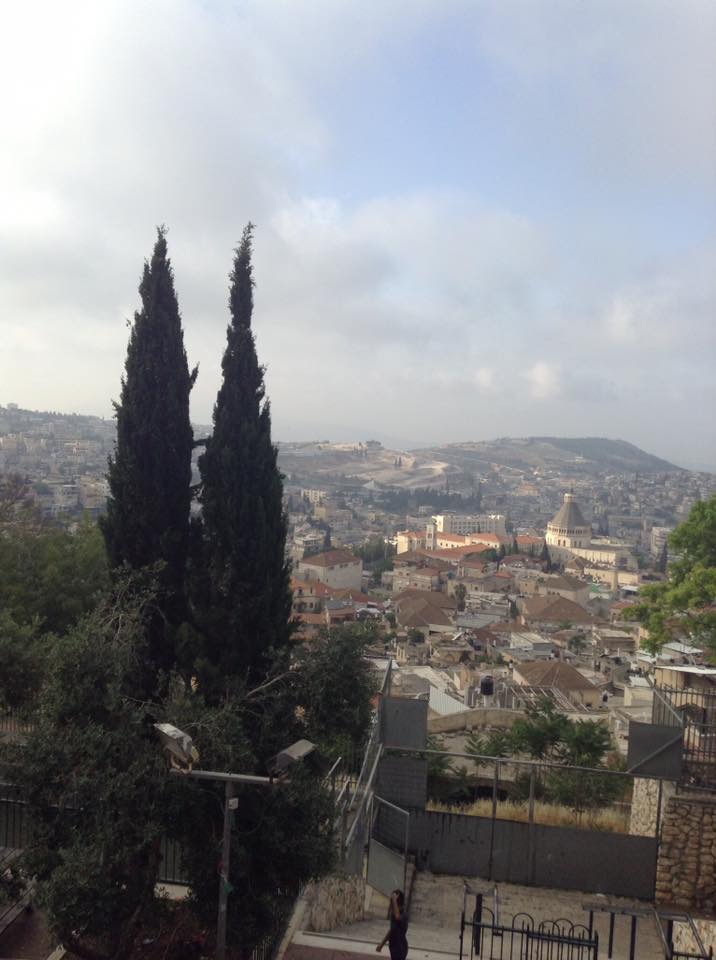
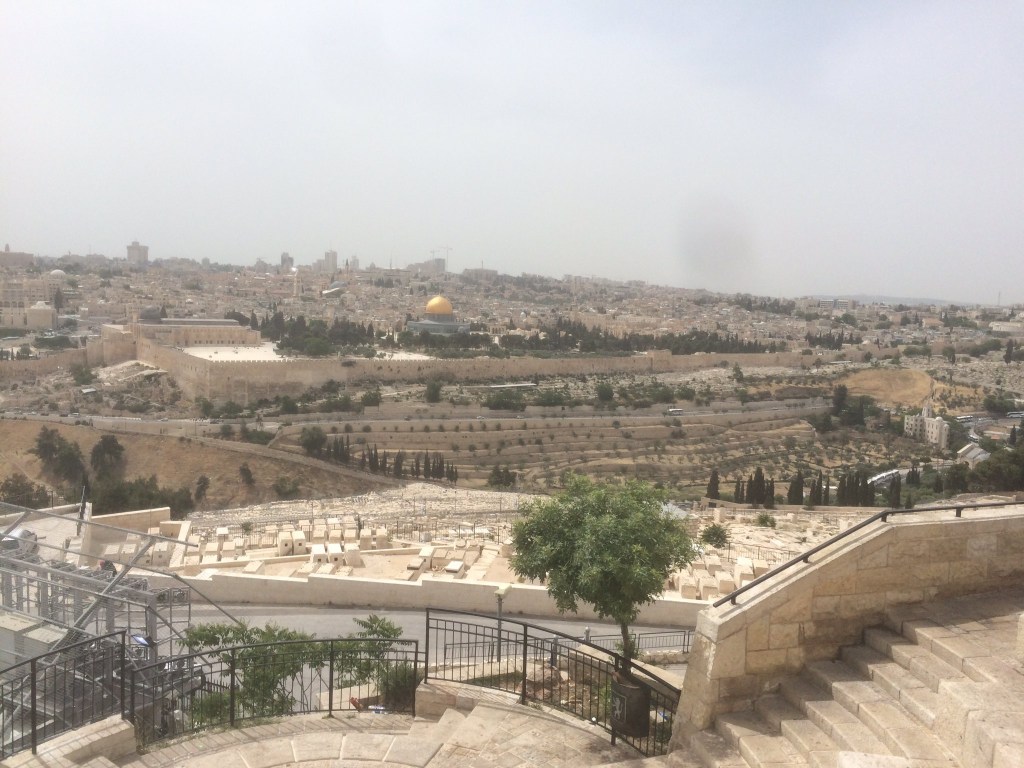
In Bible times, faithful people made a pilgrimage each year to the temple for Passover. This is why the city was so busy when Jesus and his disciples arrived before his crucifixion. The meal they shared in the upper room was the Passover meal. Today, much of the land is divided by barbed wire and concrete walls.

cemeteries on the hillside.


We work so hard at maintaining barriers, even as we know that Jesus came to tear down these divisions. We remember the words of Paul saying (Galatians 3:28) “There is no longer Jew or Greek, there is no longer slave or free, there is no longer male and female; for all of you are one in Christ Jesus.”
Pause in your devotions, and breathe in acceptance for those who have different traditions. Pray to be freed from prejudices. Place a token (a cross, a stone, a coin, or other item) beside your devotion candle as a reminder of this prayer.
Prayer: Create in me a clean heart O God, and renew a right spirit within me. Amen
Continue reading more about the city of Jerusalem as you find time:
Jerusalem has a history of great wars and great kings. The temple has been the centre of the city life for most of the time.
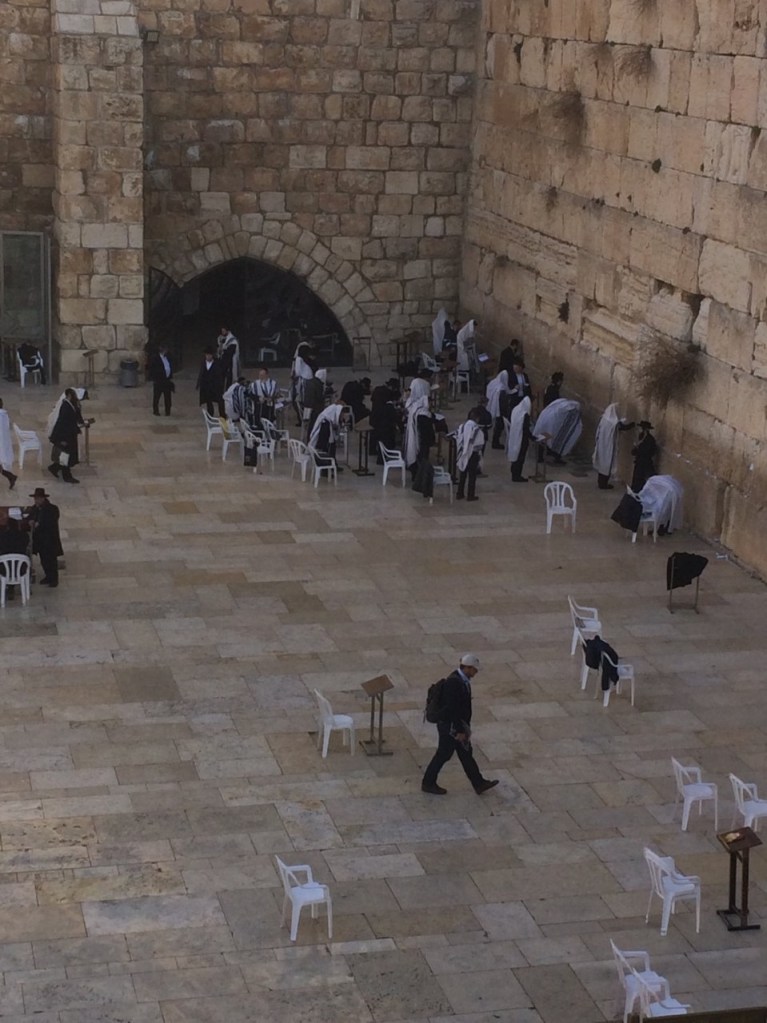
Most of the Temple was destroyed in 70CE, but a large part of the retaining wall, built by Herod to protect the temple still remains. A section of this retaining wall has been set apart and is known as The Western Wall. Jews and people of other faith traditions come to this wall and pray. Some tuck small notes in the crevices of the wall. I did not know when we visited the wall, but out of respect, people back away from the wall instead of turning their back to it when departing.
In Jesus’ time, people approaching the temple needed to stop at several places as part of their pilgrimage: they needed to change their money into temple currency; they needed to pay their temple tax, and they needed to purchase a sacrifice, anything from a small pigeon to a lamb, ram or bull.
The outline of the rooms where the sellers sat still exist. We had fun taking this photo.

Water was precious and scarce in Jerusalem. 2 Two springs existed which supplied all the water for the city. It entered through the “water gate” and was held in several pools (Mamilla Pool, Hezekiah’s Pool, the Pool of Bethesda, Solomon’s Pools, and the Pool of Siloam.)
The city was built with fortification walls, and they still exist. Gates, or archways in the wall are named, and you need to know which gate to take to access the part of the city you need to visit.
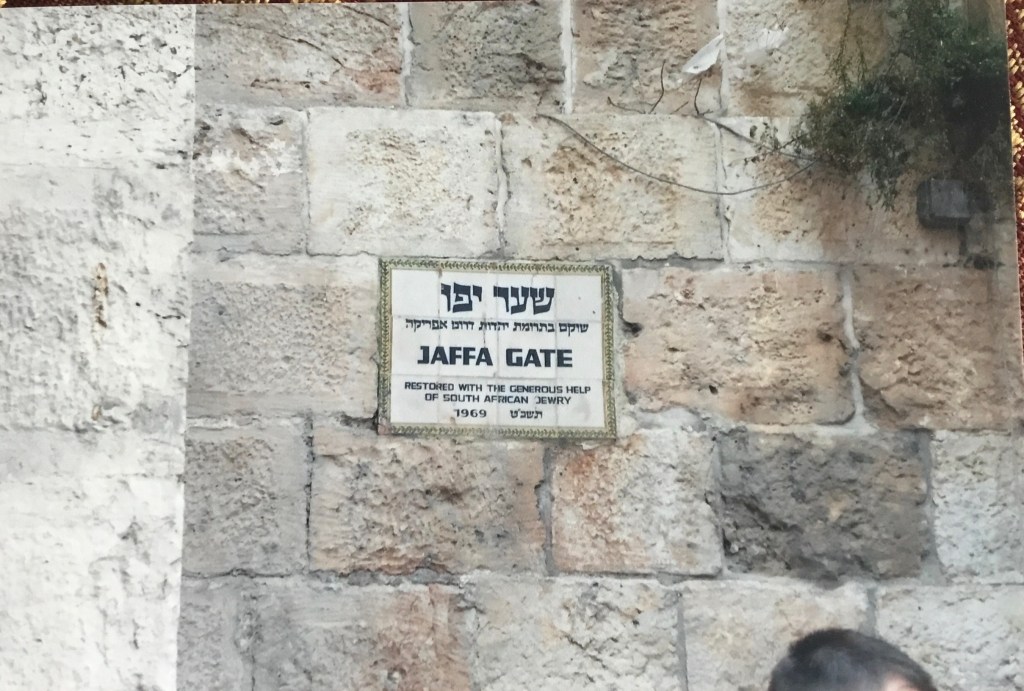
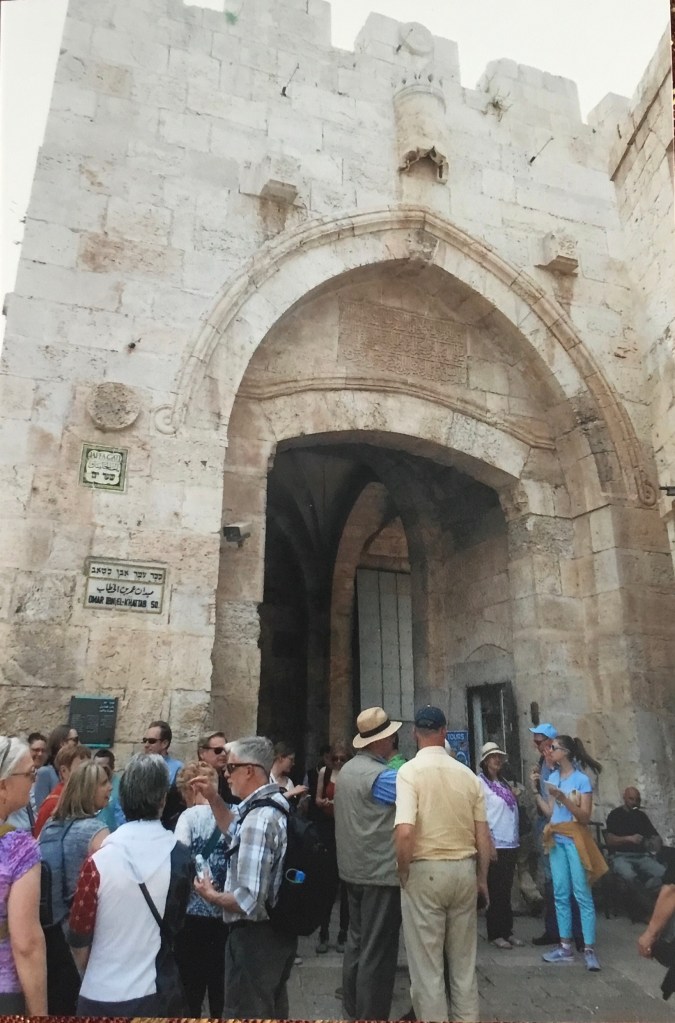
The city within the walls is a winding series of hallways lined with shops and merchants, and open spaces and winding streets. Sounds, aromas and sights are a feast for the senses, full of colour and busy-ness. And in the midst of all the hustle, it is common to see the men gathered in clusters, smoking and chatting, and conducting business. Today, and in Jesus time, the city was alive. As tourists we found it to be an exciting place. One of the gates was near a bakery cart where we purchased fresh bread every day for communion.

The name “Jerusalem” means Place of peace, (think of the word Shalom- Hebrew – , and Salam – Arabic – both which mean peace) and visitors looking for the presence of God can certainly feel it in many of the sacred locations. The city is home to 3 Abrahamic Faiths – Muslim, Christian and Jewish. As far being a place of peace, a bit more work needs to be done in that direction. We hold fast to the vision outlined in the book of Revelations chapter 21: “and I saw a new heaven and a new earth; …and I heard a loud voice saying: “see the home of God is among mortals… and he will wipe away every tear from their eyes…” The writer is describing the way things can be when God makes all things new.

This is the Lutheran Church in Jerusalem. The picture below is on the Temple Mount with the easily distinguished The Al-Aqsa Mosque. The tower of the Lutheran church is visible in the background.

This is the hope we cling to as we journey through Lent, seeking peace; seeking relationship with others and with God.
Blessings to you on this journey.
Prayer: God of grace and glory, guide us in your path to all things new. Open our hearts to receive the stranger, and to enjoy fellowship together. In your most Holy name we pray. Amen

Lent is a journey – from the wilderness to a place of being close to the heart of God.
To guide us on this journey, I invite you to join me in visiting Biblical locations in the Holy Land.
A Blessing: May God bless and keep you! May the radiant face of God shine upon you as we begin our Lenten journey from ashes and dust to the blossoming of the love of God. Amen
We begin today in the Wilderness.

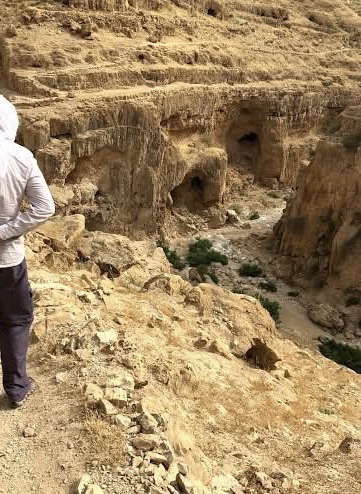
The wilderness around Jerusalem is a windswept landscape of deep valleys and high cliffs formed by ancient waters flowing through the sandy land. Today the river beds are dry, except for trickles of water in the rainy season. These dry stream beds are called Wadis (pronounced wadees). These are pictures of the Wadi Qelt which is a 25 km path between Jerusalem and Jericho. Our seminary class walked about 15 km of that path on one of the hottest days of our stay (34C)

Biblical references to the wilderness: Rubin, eldest brother of Joseph, arranged for Joseph to be thrown into a pit in the wilderness instead of being killed by his jealous brothers. Ruben planned to return and rescue him later. (Genesis 37:22) Ruben felt alone in the wilderness but God was there.
Moses met God in a burning bush in the wilderness. Moses had tried to run away and he thought he was alone but God found him in the wilderness. (Exodus 3)
The Israelites wandered in the Wilderness for 40 years complaining to Moses anbout being taken from their homes (and lives of slavery). They wavered from trusting God, but God was with them, guiding and teaching them to live as people of God. (Exodus 14:11)
Jesus was tempted in the wilderness. (Matthew 4; Mark 1; Luke 4)
sometimes life gives us wilderness times which hijack the joy of living. What wilderness time have you experienced?
as you begin your Lenten journey open your hands and release those wilderness times to God who is always with you.
Prayer: Create in me a clean heart O God and renew a right spirit within me (Psalm 51: 10) Amen
pause your devotion here, or continue reading more about the wilderness in the Holy Land to learn how the wilderness is a place where change is very noticeable and growth does happen.
More about the Wilderness in the Holy Land
The trail we walked in Wadi Qelt is believed to be the same route travelled in the parable of the good Samaratin. As we walked we could see numerous caves where bandits could hide and come upon unsuspecting travellers.
the “Valley of the shadow of death” (Psalm 23) is also thought to be the walking path through Wadi Qelt, and at some seasons of the year when small amounts of water trickle through the river beds, it is said to be a most beautiful place. The river banks sprout flowers and the trickle of water draws birds so their songs fill the air. I like that image, because it contrasts a life without God, dry and barren, and a life with God, lush and alive
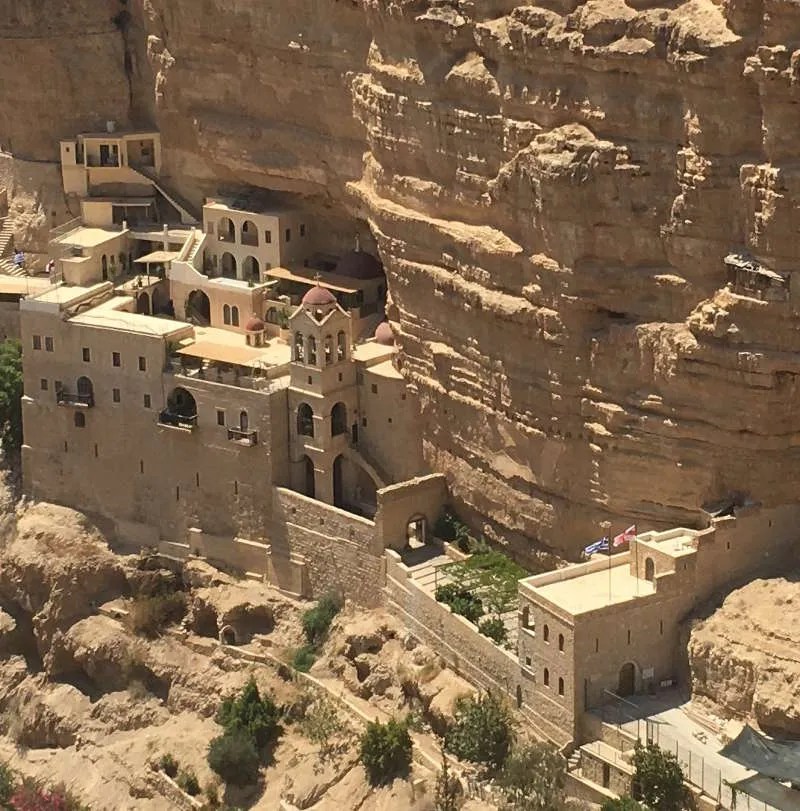
Around 500CE a monastery was constructed near the edge of Wadi Qelt, St. George’s Monastery is a Greek Orthodox cliff-hanging complex carved into a sheer rock wall in the Judaean Desert and is one of the most breathtaking sights in the Holy Land.
It is believed that Elijah visited the cave where the monastery is now located as he fled the threats of Jezebel after he killed the false prophets of Baal and Asherah. (1 Kings 19:1-3)
Around the 4th century, monks began to live in the many caves of Wadi Qelt and the monastery of St. George was founded in the 5th century by John of Thebes, an Egyptian. He gathered a small band of five Syrian hermits who had settled around the cave where they believed the prophet Elijah was fed by ravens (1 Kings 17:1–7).
The buildings were ravaged and destroyed through the years as warring nations battled and the crusaders travelled the lands.
In 1878, a Greek monk, Kalinikos, settled here and restored the monastery, finishing it in 1901.
We began our walk at the base of this monastery. It towered over us seeming to hang on the edge of the cliff, an impressive structure. The walk itself was, as you might imagine, hot and monotonous, the landscape changed very little and one horizon looked like the next. However, as we neared the end and saw buildings and palm trees I felt overwhelmed for some strange reason. I could barely speak for the emotion of having encountered an ordeal, and having made it through. That is the way of a wilderness journey. It will end and there will be joy.
In closing, bring to mind the words of Psalm 23. “Yea, though I walk through the valley of the shadow of death i will fear no evil for thou are with me. Thy Rod and staff comfort me.
Peace to you in your Lent journey.
Pastor Pam
Pamela McNeil is inviting you to a scheduled Zoom meeting.
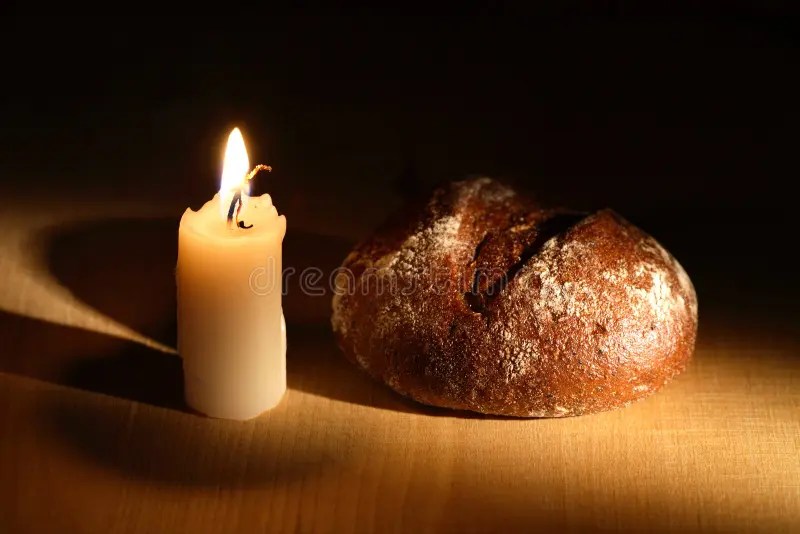
Prepare to participate in worship by setting a table with a candle, a portion of bread and wine or juice for each person, and a small dish of oil for marking your head or hand with the symbol of the cross, saying “remember you are dust, and to dust you will return.”
Topic: Ash Wednesday evening service
Time: Mar 5, 2025 07:30 PM Eastern Time (US and Canada)
Join Zoom Meeting
https://us02web.zoom.us/j/84405467135?pwd=L8OyFbafwcMvmXWU4Qdbb0JJg6DapN.1
Meeting ID: 844 0546 7135
Passcode: 454583
Dial by your location
Meeting ID: 844 0546 7135
Passcode: 454583
Find your local number: https://us02web.zoom.us/u/kcB4jazPFD

 finding Grace in Surprising Ways